
Board composition, structure and report back
Board of Directors
The Board directs the Group towards and facilitates the achievement of the Group's strategy and operational objectives. It is accountable for the development and execution of the Group's strategy, operating performance and financial results. Its primary responsibilities include: determining the Group's purpose and values, providing strategic direction to the Group, appointing the Joint Chief Executive Officers, identifying key risk areas and key performance indicators of the Group's businesses, monitoring the performance of the Group against agreed objectives, deciding on significant financial matters, approving policies and reviewing the performance of the Executive Directors against defined objectives. A range of non-financial information is also provided to the Board to enable it to consider qualitative performance factors that involve broader stakeholder interests.
The Board, which meets at least quarterly, retains full and effective control over all the operations. Additional ad hoc Board meetings are convened as circumstances require.
Board Charter
Our Board Charter assists our Board in conducting its business according to legislative requirements and the principles of good corporate governance. It ensures that each director is aware of his or her powers, duties and responsibilities when acting on behalf of the Blue Label Telecoms Group. The Board Charter is subject to the provisions of the Companies Act, JSE Listings Requirements, our Memorandum of Incorporation, and all other applicable legislation. The Board Charter covers the role and function of the Board; its detailed responsibilities; how it discharges its duties; the Board composition; and the establishment of Board Committees.
The Board has concluded that it has collectively satisfied and fulfilled its responsibilities in accordance with the charter.
Governance framework
The Board regards governance as a fundamental essential for the success of the Group's business. It is committed to applying the principles of good governance in directing and managing the Group in order to achieve its strategic objectives. The Board is the focal point for and custodian of the Group's governance framework, and is supported by its committee structures, management, shareholders and other stakeholders of the Company. The Board is ultimately accountable for the performance and affairs of the Company.
The governance framework facilitates a balance between the Board's role of providing direction and oversight with accountability to support acceptable risk parameters, consistent compliance with regulations, standards and codes relevant to the Group. At the same time the Board encourages entrepreneurship and innovation, which are recognised as key drivers of Group performance. At the operations, governance processes are aligned with the governance framework established by Blue Label. Each subsidiary company has its own board of directors and its strategy, business plan and performance criteria are clearly defined. The strategy and business plan of each subsidiary are presented to the Blue Label Board by the subsidiary's board each year. Subsidiary boards comprise Executive and Non-Executive Directors, some of whom are Executive and Non-Executive Directors of Blue Label.
Board composition
Blue Label has a unitary Board structure comprising nine Directors. Five are Independent Non-Executive Directors, while one is Non-Executive and three are Executive Directors. A biography of each Director appears here.
The Board has a balance of independent directors and non-executive directors. This is incorporated into our Board Charter, which promotes a clear balance of power and authority at board of directors' level, to ensure that no one director has unfettered powers of decision-making. In line with King IV, the roles of the Chairman and the Chief Executives are separate. The Board is led by Larry Nestadt, an independent non-executive Chairman. The Joint Chief Executives are Brett Levy and Mark Levy.
The Chairman's role includes setting the ethical tone for the Board and ensuring that the Board remains efficient, focused and operates as a unit. The Chairman provides overall leadership to the Board, without limiting the principle of collective responsibility for Board decisions. He also facilitates appropriate communication with shareholders and enables constructive relations between the Executive and Non-Executive Directors.
The Joint Chief Executives' principal role is to provide leadership to the executive team in running the Group's businesses. The Board defines the Group's levels of authority, reserving specific powers for the Board, while delegating others to Senior Management. The collective responsibility of management vests with the Joint Chief Executives who regularly report to the Board on the Group's progress in delivering its objectives and strategy.
The Group's Financial Director is Dean Suntup. The Audit, Risk and Compliance Committee is satisfied that he has the appropriate expertise and experience for this position.
The Group has implemented a succession planning process at both top level management and subsidiary management level. The succession plans are reviewed and approved by the appropriate bodies annually and documented accordingly. Furthermore, the business continuity plan for the Group has been drafted such that it incorporates the subsidiary succession plans. The Group has influential joint CEOs who co-founded the business, both of whom have a vested interest in the long-term future of the Group. However, in unforeseen circumstances, the Group has robust succession planning in place for both CEOs.
The Group considers gender equality on appointments made within the Group and the Board on an ongoing basis to ensure that the Group and the Board is sufficiently gender diverse. The Group will update its policies to address race diversity as required in terms of the JSE Listings Requirements which would be effective from 1 June 2018.
The Board has concluded that it has the appropriate mix of knowledge, skills, experience and independence.
The Remuneration and Nomination Committee annually debates the independence of its Independent Non-Executive Directors who have served on the Board for a period of nine years or more. Laurence Nestadt, Gary Harlow and Joe Mthimunye have been assessed in this regard and the committee has found them suitably independent, with continuing strong contributions.
Board composition

Board appointments
One-third of the Directors retire by rotation every three years in terms of the MoI. If eligible, available and recommended for re-election by the RNC, their names are submitted for re-election at the AGM, accompanied by a short biography set out in the integrated annual report. In this regard Messrs KM Ellerine, MS Levy and DA Suntup will be retiring at the forthcoming AGM and, being eligible, have made themselves available for re-election. Click here for a brief biography of each Director.
The RNC assists the Board with the assessment, recruitment and nomination of new Directors, subject to the whole Board approving these appointments. Board members are also invited to interview potential appointees.
A formal and transparent procedure applies to all new Board appointments, which are subject to approval by shareholders at the first AGM following that Director's appointment. Prior to appointment, candidates are required to complete a fit and proper test, as per the JSE Listings Requirements.
Mr Y Mahomed resigned as a Director of the Board and member of the Social, Ethics and Transformation Committee with effect from 11 January 2017, due to ill health. Ms P Mahanyele was appointed as a Director of the Board and member of the Audit, Risk and Compliance Committee on 1 September 2016, as a member of the Social, Ethics and Transformation Committee on 7 March 2017 and as a member of the Investment Committee on 31 August 2017.
Board effectiveness
The Board Charter provides for assessing of the Board and its committees every other year, which is recommended by King IV. In the prior year the Board and its committees assessed its performance and effectiveness according to the following categories:
- Effectiveness and composition;
- Dynamics;
- Risk management;
- Succession planning;
- Ethical leadership; and
- Corporate citizenship.
Based on the consolidated feedback from the assessment, the Board is satisfied with the overall performance and effectiveness of the Board, its members and the committees. The 2016 internal evaluation revealed no major concerns, however gender diversity aspirations were noted. In response, Ms P Mahanyele was appointed as a member of the Social, Ethics and Transformation Committee and the Investment Committee. Aligned with our gender policy we will continue to pursue gender diversification on the Board.
The Board is satisfied that the evaluation process improves performance and effectiveness.
Refer to Remuneration section for performance evaluation of CEOs against agreed upon performance measures and targets.
Evaluations of individual Executive Directors' performance take place annually, once during remuneration increase and performance bonus award periods and, as applicable, prior to the AGM regarding the re-election of Directors. Evaluations of individual Non-Executive Directors' performance takes place annually (in respect of those standing for re-election at the AGM) and for the remaining Directors every other year (as part of the Board and committee evaluations). Refer to Remuneration section for further details.
Induction of a new Director is tailored according to the knowledge and experience of the Director in a listed environment. Focus is placed on providing information on the Board structure, business operations and Group strategy. Ongoing training and development of Directors involve ad hoc presentations to the Board by professional advisers and Senior Management to ensure the Board is kept abreast of governance, regulatory and operational developments.
Company Secretary
Our Board remains satisfied with the competency and experience of our Group Company Secretary, Janine van Eden (BProc, LLB, Conveyancing). The performance appraisal of the Company Secretary for the year under review took into account the quality of support received and guidance provided to the Board. She maintains an arm's length relationship with the Board, providing guidance to Board members on execution of their duties and keeps up to date on the latest developments in corporate governance and regulation. All Directors have full access to the services and advice of the Group Company Secretary in all aspects of the Board's mandate and operations of the Group, the Board is satisfied that these arrangements are effective.
Board Committees
The Board has delegated certain functions to well-structured committees without abdicating its own responsibilities and accountability. Board Committees operate under written terms of reference approved by the Board. Board Committees are free to take independent professional advice as and when deemed necessary, for which a formal policy is in place. The Group Company Secretary provides secretarial services for the committees.
There is transparency and full disclosure from Board Committees to the Board. The minutes of committees are submitted to the Board for noting and discussion. In addition, Directors have full access to all Board Committee documentation and committee chairpersons provide the Board with verbal reports on recent activities.
The Board is of the opinion that all Board Committees have effectively discharged their responsibilities, as contained in their respective terms of reference.
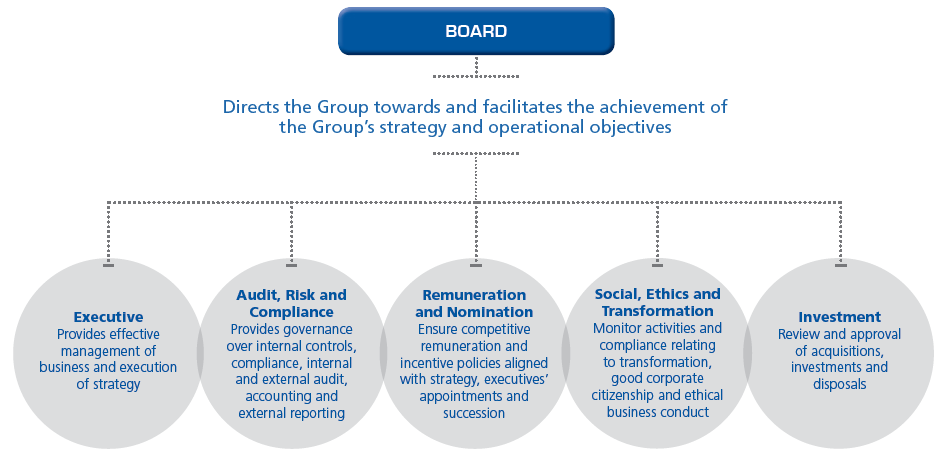
Our Board subcommittees are structured as follows:
| Attendance at meetings | ||||||||||||
| Board | Special Board |
Audit, Risk and Compliance |
Remuneration and Nomination |
Social, Ethics and Transformation |
Investment | |||||||
|---|---|---|---|---|---|---|---|---|---|---|---|---|
| Total number of meetings held during the year | 4 | 4 | 4 | 4 | 2 | 3 | ||||||
| Actual attendance/possible maximum attendance of meetings | ||||||||||||
| LM Nestadt | 4/4 | 4/4 | – | 4/4 | – | – | ||||||
| KM Ellerine | 4/4 | 4/4 | – | – | 1/2 | 2/3 | ||||||
| GD Harlow | 4/4 | 4/4 | 4/4 | 4/4 | 2/2 | 3/3 | ||||||
| BM Levy | 3/4 | 4/4 | 2/4* | 2/4* | 2/2 | 3/3 | ||||||
| MS Levy | 4/4 | 4/4 | 4/4* | 3/4* | – | 3/3 | ||||||
| Y Mahomed~ | 3/4 | 2/2 | – | – | 0/1 | – | ||||||
| P Mahanyele | 2/2# | 4/4 | 1/2# | – | 1/1o | – | ||||||
| JS Mthimunye | 4/4 | 3/4 | 4/4 | 4/4 | – | 3/3 | ||||||
| SJ Vilakazi | 4/4 | 4/4 | 4/4 | – | 2/2 | – | ||||||
| DA Suntup | 4/4 | 4/4 | 4/4* | 4/4* | –^ | 3/3 | ||||||
| DR Hilewitz | – | 1/1** | – | – | – | 3/3 | ||||||
| * | Attendee. |
| ** | By invitation. |
| o | Appointed 7 March 2017. |
| ~ | Resigned 11 January 2017. |
| # | Appointed 1 September 2016. |
| ^ | Alternate to BM Levy. |
Subcommittee structure and report back
The Board remains accountable for all matters where it has delegated responsibility to its subcommittees. The committees, their members and principal functions and focus areas are set out below:
Executive Committee
| Members and attendees | Number of meetings | ||||||
|---|---|---|---|---|---|---|---|
| MS Levy (C) | Weekly | ||||||
| BM Levy | |||||||
| DA Suntup | |||||||
| EC de Villiers* | Member attendance | ||||||
| DR Hilewitz* | 100% | ||||||
| DB Rivkind* | |||||||
| W van Reenen*# | |||||||
| (C) | Chairman. |
| * | Attendee. |
| # | Resigned on 31 July 2017. |
Key objective and terms of reference (TOR)
The Group Executive Committee is responsible for managing the business and affairs of the Group, implementing the strategies and policies of the Group and establishing and maintaining best management practices and standards.
The Executive Committee currently has authority to make any decision to purchase or dispose of assets and otherwise enter into any transaction outside the ordinary course of business, subject to the maximum value of the transaction not exceeding R40 million.
The Executive Committee has concluded that it has fulfilled its responsibilities in accordance with its terms of reference.
2017 Focus areas and activities
In addition to discharging its obligations in terms of its terms of reference, during the year under review the Executive Committee managed and implemented several large and challenging acquisitions.
Refer to CEO discussion and operational review for further details.
2018 Focus areas
Key focus areas of the Executive Committee during the 2018 financial year shall include assimilating acquisition targets into the Group and ensuring that the historic business units and new acquisitions:
- adhere to the strategies and policies of the Group;
- adhere to best management practices and functional standards;
- adhere to legal compliance and internal control; and
- are efficiently and competently managed.
Audit, Risk and Compliance
| Members and attendees | Number of meetings | ||||||
|---|---|---|---|---|---|---|---|
| JS Mthimunye (C) | 4 | ||||||
| GD Harlow | |||||||
| P Mahanyele | |||||||
| SJ Vilakazi | Member attendance | ||||||
| EC de Villiers* | 93% | ||||||
| BM Levy* | |||||||
| MS Levy* | |||||||
| DA Suntup* | |||||||
| (C) | Chairman. |
| * | Attendee. |
Key objective and terms of reference (TOR)
Provides governance over internal controls, compliance, performance of internal and external audit, appropriateness of accounting and adequacy of external reporting.
The Audit, Risk and Compliance Committee concluded that it has fulfilled its responsibilities in accordance with its terms of reference.
2017 Focus areas and activities
- examining and reviewing the Group's financial statements and reporting of interim and final results;
- reviewing and considering, for recommendation to the Board, the consolidated budget for the ensuing financial year;
- overseeing integrated reporting;
- overseeing the Internal Risk and Compliance Committee function;
- monitoring the risk management framework and assessing the risks that impact on the Group's ability to achieve its strategic objectives;
- reviewing and satisfying itself of the expertise, resources and experience of the Blue Label finance function;
- overseeing the internal audit function and internal financial control process;
- recommending the appointment of the external auditor and overseeing the external audit process, including their audit fee, independence and nature and extent of any non-audit services; and
- monitoring compliance activities.
Refer to governance of risk, technology and information governance, combined assurance and to the Audit, Risk and Compliance Committee report for further details.
2018 Focus areas
- Successful integration, accounting treatment of acquisitions, establish compliance framework for the Group with specific focus on foreign operations.
- Assessing the impact of IFRS 16.
- Continued focus on King IV transition.
Remuneration and Nomination
| Members and attendees | Number of meetings | ||||||
|---|---|---|---|---|---|---|---|
| GD Harlow (C of RC) | 4 | ||||||
| LM Nestadt (C of NC) | |||||||
| JS Mthimunye | |||||||
| EC de Villiers* | Member attendance | ||||||
| BM Levy* | 100% | ||||||
| MS Levy* | |||||||
| DA Suntup* | |||||||
| (C) | Chairman. |
| * | Attendee. |
Key objective and terms of reference (TOR)
Ensure competitive remuneration and incentive policies aligned with strategy, review design and targets of the Group's forfeitable share plan and review associated annual awards under the share plan, executive and non-executive appointments and succession, annual evaluation of independence of Non-Executive Directors and composition of Board and its committees.
The Remuneration and Nomination Committee concluded that it has fulfilled its responsibilities in accordance with its terms of reference.
2017 Focus areas and activities
- ensuring that the Group upholds its entrenched remuneration philosophy;
- ensuring that the combination of fixed and variable pay is appropriate when benchmarking remuneration levels;
- reviewing incentive schemes aligned to growth in shareholder value;
- reviewing incentive schemes to ensure that they are administered and implemented in terms of their rules and performance targets;
- reviewing remuneration of Executive Directors and Senior Management;
- submitting recommendations to the Board with regard to non-executive remuneration for ultimate approval by shareholders;
- managing stakeholder relations and expectations, as deemed appropriate on remuneration matters;
- ensuring that the Group continues to progress with race and gender diversity on the Board and committees; and
- ensuring that the Group has implemented succession planning at both top level management and subsidiary management level.
Refer to Remuneration report for further details on our remuneration philosophy, policy and implementation.
2018 Focus areas
Continue to ensure that total rewards are set at levels that are competitive and drive performance in the short and long term ensuring alignment with shareholder interest and at the same time promote an ethical culture and responsible corporate citizenship.
Social, Ethics and Transformation
| Members and attendees | Number of meetings | ||||||
|---|---|---|---|---|---|---|---|
| SJ Vilakazi (C) | 2 | ||||||
| KM Ellerine | |||||||
| GD Harlow | |||||||
| BM Levy (alternate DA Suntup) | Member attendance | ||||||
| Y Mahomed~ | 80% | ||||||
| P Mahanyeleo | |||||||
| MJ Campbell* | |||||||
| EC de Villiers* | |||||||
| IJ Hindley* | |||||||
| (C) | Chairman. |
| * | Attendee. |
| o | Appointed 7 March 2017. |
| ~ | Resigned 11 January 2017. |
Key objective and terms of reference (TOR)
Monitor the Group's activities and compliance with legislation relating to equality, black economic empowerment, good corporate citizenship, the environment, health, public safety, and consumer and labour relations, as well as advise the Board where necessary and appropriate. Review ethical business conduct, including any activity on the ethics hotline.
The Social, Ethics and Transformation Committee concluded that it has fulfilled its responsibilities in accordance with its terms of reference.
2017 Focus areas and activities
Focus areas for the year have been the following:
- the alignment of business strategy and practice to ensure appropriate B-BBEE ratings;
- the tracking of Group performance against employment equity targets;
- monitoring Group learning and development initiatives such that they are aligned with strategic intent and B-BBEE requirements;
- the alignment of Group CSI, enterprise development and supplier development strategies and the creation of a shared value model between the various beneficiaries and the Group; and
- monitoring and supporting Group health and safety policies and practices.
Refer to Social, Ethics and Transformation Committee report, and to Effective and Ethical Leadership and Stakeholder Relations sections for further details.
2018 Focus areas
- To continue to ensure the alignment of business strategy to B-BBEE requirements with particular emphasis on the JSE regulations regarding a Group consolidated scorecard.
- To continue to track Group performance against employment equity targets.
- To continue to monitor the Group learning and development initiatives such that they are aligned with strategic intent and B-BBEE requirements.
- The scale up the Group CSI, enterprise development, and supplier development initiatives through the formation of a Foundation as an enabler for the shared value model between the various beneficiaries and the Group.
- To continue to monitor and support Group health and safety policies and practices.
Investment (ad hoc, minimum two meetings)
| Members and attendees | Number of meetings | ||||||
|---|---|---|---|---|---|---|---|
| GD Harlow (C) | 3 | ||||||
| KM Ellerine | |||||||
| DR Hilewitz | |||||||
| BM Levy | Member attendance | ||||||
| MS Levy | 95% | ||||||
| JS Mthimunye | |||||||
| DA Suntup | |||||||
| EC de Villiers* | |||||||
| (C) | Chairman. |
| * | Attendee. |
Key objective and terms of reference (TOR)
- Reviewing acquisitions, investments and disposals made within the Executive Committee's mandate.
- Reviewing, considering and approving proposed acquisitions, investments and disposals of the Group recommended by the Executive Committee ranging between R40 million and R100 million per transaction.
- Reviewing, considering and recommending to the Board acquisitions and investments of the Group above R100 million.
- Annually review the performance of each investment and acquisition made.
The Investment Committee concluded that it has fulfilled its responsibilities in accordance with its terms of reference.
2017 Focus areas and activities
Blue Label's strategy is to grow its businesses organically and to enhance its competitive advantage and offering to its customers through strategic acquisitions. All new investments which are considered have to be motivated by alignment with Group objectives, strategic focus and they have to enhance future profitability. Among the considerations are the requirements that the future returns exceed Blue Label's weighted average cost of capital (WACC), enhance Blue Label's service and product offerings or complement existing ones, attract new skills and management and offer synergy benefits.
The main challenge is that Blue Label operates in a rapidly developing and highly competitive market where the customer is "king". Acquisitions need to be strongly motivated to the investment committee to meet these challenges.
Past acquisitions over the previous four years are reviewed annually in terms of actual performance compared to budget and whether they met the criteria set when they were initially approved by the Investment Committee. Any sub-performance is analysed in full to assist the committee in shaping its criteria for future acquisitions as well as advising management on corrective steps to be taken.
In August 2017 the Cell C and 3G acquisitions were implemented.
2018 Focus areas
As the Group is in the expansion phase of its development, further acquisitions are being pursued and appraised and are likely to continue in the next financial year.
A challenge for the committee will always be to look at ways of retaining the entrepreneurial management teams that come with these acquisitions through our long-term share plan.