It gives me great pleasure to present our FY25 Remuneration Report. This year has certainly seen a significant improvement in performance outcomes for BLU with the Group delivering highly commendable results, exceeding financial and operational targets.
Core headline earnings surged to more than double the budgeted figure, which was demonstrated by strong operational execution across most business units and the successful implementation of the Cell C turnaround strategy. The Group maintained exemplary financial discipline, meeting all banking facility obligations and covenants, and securing additional facilities to support Cell C's recapitalisation and future listing. This financial stewardship has ensured ongoing stability and flexibility. Risk management and compliance were prioritised as key KPIs, with substantial progress in strengthening the Group's risk framework and embedding best-practice governance. These efforts have materially improved risk identification, monitoring, and mitigation, supporting long-term sustainability and oversight.
On the transformation front, BLU maintained a Level 4 B-BBEE compliance, reflecting a deep commitment to inclusive and sustainable business practices. The Group continues to focus on interventions to improve gender and diversity at management level.
Finally, the Group's focus on customer relationships and retention, particularly with major financial institutions, has further solidified its strategic position and underpinned ongoing growth. In summary, the company's performance in FY25 has not only delivered materially better financial results. Still, it has also strengthened the Group's risk, compliance, and customer foundations – positioning BLU for continued sustainable growth and increased shareholder returns.
The fast-changing operational and business dynamic that we find ourselves in as a company, against a backdrop of significantly improved performance, heightens the complexity within which the Committee has to make decisions. We remain acutely aware of the critical role that our remuneration frameworks and policies play in driving the right outcomes and supporting long-term success. We therefore strive to ensure that our remuneration practices, particularly in respect of the Executive Directors are closely aligned with our performance and implemented in a manner that is both fair and fit for purpose in achieving the intended outcomes.
Our remuneration policy, and the accompanying implementation report were tabled for shareholder voting at the AGM held on 28 November 2024, receiving 58% support respectively. As the outcomes reflected a decline from prior years, we engaged actively with shareholders to better understand and address their concerns. Significant progress has since been made, and we believe that the policy enhancements outlined below and improved disclosures, will be positively received. These refinements demonstrate that our shareholder engagements remain open and constructive, and that the feedback provided has been carefully considered in implementing fit-for-purpose changes where relevant.
It remains critical that our remuneration policy achieves our goals of attracting and retaining top talent and, importantly, driving the improved performance outcomes we are seeing. Accordingly, the Committee will constantly evaluate how the policy should be adapted and changed to ensure that BLU achieves this goal while remaining aligned with market/best practice. We will continue to monitor and tweak as necessary in an ever-changing, fast-paced, dynamic environment. Remuneration is one of our biggest levers and is fundamental as part of our holistic employee value proposition.
The key changes to our policy for FY26 relate largely to adopting of new metrics for the forward looking long-term incentive (LTI) awards, removing the individual component of the scorecard and replacing this with a balanced scorecard covering ESG and strategic milestone and introducing a Total Shareholder Return pillar. Our LTIP now has 80% of its performance outcomes evaluated against financial and shareholder performance (vs. 60% for previous awards) with the remaining component being assessed against a balanced scorecard described above. Our LTIP target incentive payouts remain unchanged, while higher stretch outcomes are now associated with the increased weighting of financial metrics. We have also refined our short-term incentive (STI) framework and introduced the concept of a balanced scorecard for the individual components. No changes were made to target executive management pay, and executives’ pay increases were kept at a lower percentage than those for general staff. These changes are expanded upon in this report, specifically in sections relating to shareholder feedback and in section 2, which outlines the forward looking policy and in the enhanced disclosures in section 3 of the implementation report.
We also conducted a comprehensive review against what is considered as best-practice guidance as described by large proxy advisers and are further encouraged that we are well aligned to best practice across all the key elements from a remuneration policy and implementation perspective, with the above changes further improving our alignment across the following key areas summarised below:
| Best practice and common areas of concern | Current alignment to best practice | Changes | ||
| Performance period and short-term focus: LTIPs with performance periods should not be less than three years to ensure firms do not reward annual/medium-term outcomes twice rather than long-term performance. | BLU’s performance periods are aligned with best practice. Three years for LTIPs with a cliff vest. Annual Cash incentives. | Already market aligned – No change required. | ||
| Complex structures: Overly complicated incentive arrangements impede outcomes assessment and should be avoided. | Current architecture is market aligned with an annual cash STI and a 100% performance-based CSP plan. | Already market aligned – No change required. | ||
| Insufficient performance conditions: Lack of pre‑determined performance targets or a clear linkage between pay and performance metrics. | BLU have defined performance metrics/conditions. All awards already had performance conditions. | Further enhancement with new Metrics for LTI , transparency concerning individual metrics and targets in the STI and a balanced scorecard approach in the future. | ||
| Excessive pay: Total remuneration exceeding peer group levels without justification. | Detailed remuneration review yielded no change to target pay and target policy. This is consistent with the last few years. The current construct is market-related regarding pay opportunity and is not overly leveraged or excessive. | No change to target pay outcomes. Already market aligned – No change required. | ||
| Disclosure: Insufficient disclosure of performance metrics, targets, and methodology behind compensation decisions. | Further ex-post disclosure and transparency. | Ex-post disclosure of STI and ex-ante disclosure of LTI are in this report. | ||
| Excessive discretion: Remuneration committees are unlimited in determining awards without defined parameters. | The RemCo only apply discretion in relevant circumstances. Adjustments made are for consistency purposes only. Management was negatively affected by the consistent adjustments made this year, which ensured consistent application of principles. |
Already market aligned – No change required. | ||
| Change of control provisions: Automatic acceleration of vesting or inappropriate termination payments during a shift in control. | No acceleration. Appropriate controls are in place. | Already market aligned – No change required. | ||
| ESG integration: ESG metrics in incentive scorecards. | Relevant and not overweight. Part of a balanced scorecard. | Already market aligned – No change required. | ||
| Uncapped vesting: Incentive plans lack maximum limits on potential payouts. | There is a stretch vesting cap. | Already market aligned – No change required. | ||
| High dilution: Share plan limits exceed recommended thresholds for issued share capital. | The current updated plan is non-dilutive in nature. Award levels and leverage are not excessive with caps at stretch. | Already market aligned – No change required. | ||
| Response to shareholder feedback interaction and reactions to previous significant votes against remuneration proposals. | The Committee engaged and made changes where appropriate. | Policy changes made in FY26 and enhanced disclosure in the implementation report. | ||
| Retention awards: Time-based retention awards are granted without performance conditions. | Not applicable. BLU doesn’t utilise such awards unless in buy-out scenarios. Executive variable pay is 100% performance based with no complicated matching or restricted awards in place. | Already market aligned – No change required. | ||
| Malus and clawback provisions: Mechanisms for recovering inappropriate payments. | BLU has detailed malus and clawback provisions. | Already market aligned – No change required. |
This remuneration report aligns with the King IV principles to articulate and demonstrate the link between strategy, value creation, performance and good remuneration practices. Section 1 of this report provides an overview of how the Committee has championed our alignment with the King IV Code on Corporate Governance, our areas of focus in the achievement of our policy objectives and changes, stakeholder engagement and our efforts to build a performance culture through values and our purpose and alignment with performance and rewards.
Section 2 details our forward looking remuneration philosophy and policy, together with an overview of our total reward strategy. We made several substantial changes to our performance conditions for the LTIP in the future, as described above, which further improved the performance and reward construct to better effect the desired outcomes and design with balanced scorecards for the individual components of the STI, ESG and strategic milestones for the LTI plans.
Finally, section 3, the remuneration implementation report, provides an overview of our 2025 performance and discloses our performance against targets and resulting awards to Executive Directors, Prescribed Officers as well as the fees paid to Non-Executive Directors. Enhanced disclosure and narrative provide context and detail on how outcomes and outturns were determined for FY25.
Looking forward to 2026, we will continue to review the success of our remuneration policy in terms of both our goals and those of our stakeholders and change as is necessary to affect the right outcomes in a fast-paced dynamic economic and business environment.
We continue to invite comments and inputs from our shareholders as part of our efforts to review and improve this policy continuously and I am pleased and grateful to report that the Human Capital team at Blu Label and the Blu Label Remuneration Committee (the Committee) place significant and increased emphasis on good corporate governance practices, focusing on the principles of pay for performance and fair and responsible remuneration to drive the right outcomes.
Our continued focus, business strategy and execution are bearing fruit, and we look forward to FY26 and beyond.
Chairman
30 September 2025
After each meeting, the Committee Chairman provides the Board with feedback, highlighting key decisions and relevant discussions. We remain committed to applying the relevant King IV principles for responsible and transparent remuneration practices, supported by regular benchmarking exercises and aligned with the applicable legislation and Companies Act requirements.
BLU collaborates with its remuneration consultants, Deloitte, to review and refine its remuneration policy and overall variable compensation practices to ensure they are fair, transparent and drive the right outcomes.
During 2025, the Committee made significant progress across key executive and management remuneration, succession planning, and governance areas supporting the Company's strategic direction and alignment with market benchmarks. Key highlights include:
Remuneration review: Deloitte was engaged to conduct a comprehensive review of the Group's total remuneration framework, including fixed pay, incentives, and market comparisons. Insights from this process have informed the evolution of our remuneration policy and practices, with appropriate adjustments to performance metrics to support long-term strategic success.
Long-term incentives: The Committee evaluated and refined long-term incentive plans (LTIPs), ensuring more substantial alignment with shareholder interests and company performance.
Market competitiveness: Ongoing monitoring of remuneration trends has ensured the Company remains competitive in attracting and retaining high-calibre talent.
Performance alignment: Continued executive bonus and incentive metrics oversight ensures alignment with strategic and long-term organisational objectives.
Fairness, equity and inclusion: Regular assessments confirm that remuneration practices promote fairness, equity, and diversity across all staff levels.
Regulatory readiness: We remain aware and responsive to proposed amendments to the Companies Act, particularly regarding remuneration disclosures and governance, and are prepared to adapt to new requirements.
Stakeholder engagement: Constructive engagement with shareholders has improved policy and disclosure, reflecting ongoing dialogue and commitment to transparency.
Succession and leadership development: Significant strides have been made in succession planning, supported by leadership and mentorship programmes, ensuring the development of a strong, diverse, and sustainable leadership pipeline throughout the Group.
Our commitment to ESG remains steadfast and continues to be a pillar that we measure management against in our long-term incentive while we are actively working toward continuing to achieve our gender and pay parity goals over the next few years. Enrolment in leadership development programmes continues to increase and we will continue developing leadership talent that is equipped for the future.
We are deeply committed to building a sustainable talent foundation for long-term success.
Blu Label's remuneration philosophy and policy continue to attract, retain, and motivate employees effectively. We recognise the ever-changing business environment and will maintain a flexible approach in 2026.
There were no requests to deviate from the established remuneration policy in 2025. The Committee adjusted for the “normalisation” of EBITDA and core HEPS to account for the extraneous contributions relating to the Cell C recapitalisation’s accounting treatment and learnership programme expenses, as explained to shareholders previously.
This ensures that there is a fair view of performance against the business plan. Indeed, by adjusting consistently, management was worse off in 2025 in achieving EBITDA, EBITDA where the shortfall against the business plan was 7% compared to an unadjusted 6%. Again, the Committee ensures that it is prudent in its application of the policy and that fair performance-related outturns are aligned with the performance of the business, which has improved significantly year on year together with recognition in the market of the execution against our strategy, where our share price has seen strong performance.
Our EVP reflects the vibrant culture and unique experience of being part of something bigger and we continue to build an inclusive leadership culture, fostering a ‘performance with purpose’ mindset. The Committee recognises the continued importance of the following areas as in prior years and the implementation and effectiveness of these in relation to our performance and reward outcomes is fundamental in assisting in our growth journey:
Paying for performance remained at the core of BLU’s and the Committee’s philosophy. For 2026, the Committee approved an overall increase of 6% for employees and 4% for executives. These decisions were made in light of inflationary estimates and market movements, using key skills sets to ensure that we stay true to our pay positioning philosophy. The lower increases for the executives reflect a conscious differentiation between pay at the top of the organisation and that at the lower end, reflecting our continued journey to ensure fair pay while reducing the pay gap.
At Blu Label, we are committed to creating a diverse, equitable, and sustainable work environment. This commitment extends to ensuring fair compensation practices and embedding ESG principles within our remuneration framework. Currently, 10% of our LTI performance indicators (KPIs) are directly linked to ESG objectives.
We continuously refine our approach to promoting pay equity and integrating ESG considerations into our remuneration framework. By focusing on these areas, we aim to attract and retain top talent, build a more sustainable and responsible organisation, and deliver long-term value for our stakeholders.
Blu Label’s remuneration metrics include ESG targets to ensure that Board members and senior executives align their objectives and performance with the Company’s strategy, while effectively managing its impact on people, the environment, and the economy.
The ESG metrics included in the 2026 conditional share plan performance targets will be based off a balanced scorecard across the performance period.
The specific weighting of these categories and the success rate in achieving ESG-linked KPIs will be reviewed internally.
In line with the JSE Listings Requirements and King IV, we will table the following resolutions for shareholders voting at the AGM:
Shareholders are invited to engage with us regarding our remuneration policy and this remuneration report by sending a request for engagement to the Chairman of the Committee at [email protected].
Our remuneration policy and implementation reports were submitted for two separate non-binding advisory votes at the 2024 AGM held on 28 November 2024.
The voting outcomes are set out below:
| Ordinary resolution number 9: Non-binding advisory endorsement of the remuneration and reward policy | For: 58% Against: 42% |
| Ordinary resolution number 10: Non-binding advisory endorsement of the remuneration implementation report | For: 58% Against: 42% |
In response to the voting outcomes outlined above, the Committee engaged with shareholders by inviting them to submit written feedback on the remuneration policy and remuneration implementation report. We also met with several shareholders to understand the key areas of concern. As reflected in this report, several changes were made to improve our policy and its implementation.
Our actions and work undertaken is summarised in the following table.
| Shareholder concern | Our response and actions |
| Clarity and sufficiency of performance conditions | The Company recognises the importance of clear and robust performance conditions. Both the STI and LTI schemes are already fully performance-linked and structured to align with the corporate strategy. For FY26, the STI will adopt a more transparent balanced scorecard approach, especially for the individual performance component. At the same time, the LTI Executive variable pay is 100% performance based with no complicated matching or restricted awards in place. |
| Disclosure around performance targets, remuneration outcomes, and methodologies behind compensation decisions | The Company has responded by enhancing disclosure practices. There is now improved ex-post disclosure of the metrics used and the actual outcomes achieved for the STI. For the LTI, the Company has committed to ex-ante disclosure of the performance criteria, providing shareholders with clarity on how future awards are determined. The methodologies for calculating both current and future incentive awards have been standardised and clarified. The Company is committed to ensuring consistency, fairness, and transparency in applying and disclosing these metrics and outcomes. |
| Pay levels, competitiveness, and market alignment | A comprehensive benchmarking review, led by Deloitte, was conducted to assess all elements of fixed and variable pay. The findings confirm that the Company’s target pay levels are not excessive and are aligned with the market median, with stretch pay opportunities in the LTI remaining below market-related levels. No changes have been made to target pay levels, reflecting a prudent approach. The revised LTIP ensures that 80% of incentives are linked to financial or shareholder return, with additional stretch incentives introduced for outperformance, further aligning with market practices. The remuneration framework will continue to be informed by market conditions and strategic requirements, rather than simply following market trends, and is designed to encourage superior performance, particularly on key financial measures. |
| Discretion and adjustments made to metrics | Discretion is only applied in exceptional and well-justified circumstances within clearly defined parameters. The use of discretion is reviewed annually and, where exercised, is disclosed with appropriate narrative. Adjustments to any metrics are applied consistently on a like-for-like basis each year to ensure there is no unfair advantage or disadvantage to management. This approach is regularly debated within committee meetings to ensure fairness, and it is noted that this year, the consistent application of adjustments resulted in a negative impact on management, underscoring the Company’s commitment to fair alignment. |
In the 2026 financial year, the Committee will focus on the following:
The Committee remains committed to transparency and responsible practices in 2026 and beyond. We will continue refining the remuneration framework to meet Blu Label's evolving needs and to ensure it attracts, retains and motivates top talent.
Our remuneration philosophy, policy and framework at Blu Label, recognises that our people are among our greatest assets. We believe providing an environment where individuals can thrive and grow in their careers while collectively driving the organisation’s success is vital. Our remuneration policy and practices, along with our WeLead programme, aim to foster resilience, drive achievement, and cultivate a winning mindset.
We differentiate ourselves from our peers through our EVP and employee engagement strategy. Our “all-in” culture creates a safe environment that enhances productivity and fosters innovation.
Our remuneration policy enables us to:
This applies to all subsidiaries, associates and joint venture companies in which Blu Label holds a shareholding of over 40%, excluding Cell C, which has its own remuneration policy and committee. The Committee may approve by exception, the policy to apply to Blu Label employees seconded to Cell C.
Our objective is to be an employer of choice, and our employee brand and reward programme are designed to help us achieve this distinction.
We benchmark guaranteed pay practices locally to ensure our remuneration packages are competitive and relevant to the role and experience required.
Deloitte provided a market snapshot for 2024/25 and these benchmarking exercises are conducted annually to ensure alignment with industry standards and best practices. They are presented to the Committee to determine increases, remuneration quantum, and policy adjustments each year.
We are committed to a pay-for-performance philosophy, structuring remuneration to reward both individual and organisational excellence. We apply malus and clawback provisions to the short-term incentive plan (STIP) as well as vested and LTIP awards for management.
We strive to ensure employee remuneration differences are based on fair and objective criteria. The Committee has a policy in place to monitor and continuously address any issues related to fair pay. We continue to build on our pay equity and fair pay analysis undertaken over the past two years and are also conscious of the amendments to the Companies Act and the associated reporting requirements once it is implemented.
Our strategy for horizontal pay equity has proven effective, contributing to employee retention and transformation and we continue to evolve our analysis to inform that the right changes are made.
Our goal remains to create an inclusive workplace where employees can bring their whole selves to work and live out their purpose. Our comprehensive strategy emphasises diversity and inclusive leadership, ensuring a supportive and fair work environment.
At Blu Label, we adopt a holistic approach to remuneration, incorporating guaranteed pay, variable pay, recognition, employee development, and benefits. We understand that the remuneration policy’s philosophy and individual components are dynamic and must be reviewed regularly to stay aligned with our objectives and market trends. We ensure full compliance with legislative and regulatory requirements.
We provide all employees with clear and transparent information about our reward programmes, policies and processes, ensuring they understand what they receive, why and when.
Annual incentivisation remains directly linked to business plans and budgets for the year in question juxtaposed against individual performance in the role.
These business plans are developed by the subsidiary executive committees and reviewed by the Group Executive Committee. Following this, the Blu Label Executive Committee approves the plans, with final approval for the Group’s consolidated business plan granted by the Board of Directors. Robust targets and metrics are set against each business that look to drive the performance and associated remuneration of employees annually.
Long-term incentivisation is linked to the business’s long-term performance (three years), of the business measured against key financial, strategic and shareholder return metrics. These are evaluated annually for relevance driving long-term business outcomes and assisting in retaining and attracting of key skills and employees to our business.
Blu Label’s reward framework consists of financial and non-financial components and applies to all employees. The framework includes:
At Blu Label, the pay-mix may vary depending on seniority, business needs, such as relocation or international assignment costs and allowances. We reimburse all necessary and reasonable business expenses.
Guaranteed
|
Variable
|
Non-financial
|
||||||
| Fixed annual remuneration | Sales commissions | Short-term incentive plan | Short-term variable remuneration | Long-term incentive plan | Employee value proposition | |||
| Objectives | It enables us to attract and retain talent, taking into consideration skills, experience, high potential and value contribution. | Aligned to drive continuous improvement, improved customer service and increased revenue in sales and operations. | Reward the achievement of challenging strategic, financial and operational objectives, aligning individuals with divisional and Blu Label performance and the interests of our shareholders. The scheme rewards collaborative work across Blu Label to ensure we leverage our capabilities, increase innovation, improve customer and consumer service, reduce inefficiencies and increase revenue and profits. | Special-purpose variable remuneration arrangements to help attract and retain high-potential talent who are the holders of scarce skills. Arrangements are subject to individual performance and time-based conditions to ensure an appropriate return on the remuneration investment. | Aligning employees to shareholder interests by incentivising performance aligned with strategic goals and long-term shareholder value. | Create a differentiated EVP and work experience to increase the engagement and retention of existing employees and position Blu Label as an employer of choice within an increasingly competitive landscape, focusing on employee experience. | ||
| Eligibility | All. | Specific roles within sales and operations. | All. |
|
Executives and management. | All. | ||
| 2026 approach |
The Committee recommended up to 6% increases for 2026. Higher increases were awarded on the exception to retain critical skills and high-performing talent. The Committee approved an overall increase of 4% for executives. |
As defined by the operational plan and budget. |
Schemes with varying components linked to:
Gatekeeper conditions are in place. The following financial measures will be applied in determining the STIP for Blu Label head office and Executive Directors:
The following financial measure will be applied in determining the STIP at divisional levels:
Varying weighting applies based on relevance and group vs individual impact. Individual performance only accounts for 20% of Executive Director pay and is linked to a strategic scorecard with associated ratings thereon. |
Cash-based sign-on awards and retention bonuses are assessed on a case-by-case basis in line with policy. |
Conditional shares are offered under the 2025 CSP plan. Performance metrics may vary depending on strategic requirements. Changes for FY26 and metrics resulted in the removal of the strategic balanced scorecard and individual KPI’s and an introduction of total shareholder return as a key metric used for performance evaluation. The following metrics apply:
|
Individualised employee engagement, development and growth. |
||
FAR is critical in attracting and retaining top talent, considering factors such as skills, experience, potential, and value contribution. The components of guaranteed fixed remuneration include:
We utilise industry and country-relevant benchmarks provided by Deloitte to ensure we offer competitive remuneration. Fair and competitive compensation is essential to maintaining our position as an employer of choice.
Blu Label’s annual salary review process allows management to recognise performance and adjust salaries per market trends and organisational affordability. We aim to differentiate between non-performance, average performance, and exceptional performance. For 2026, the Committee approved an overall increase of 6% for employees and 4% for executives recognising the requirement to differentiate between staff at varying levels of seniority and also to further close the pay gap between those at the lower levels vs. the more senior staff. Higher increases may be awarded in exceptional cases to retain critical skills, high-performing talent, or when a role has expanded in scope and responsibility.
Our STIP rewards the achievement of key short-term objectives, combining both financial and non-financial metrics. In addition to financial performance, the STIP encourages self-development, developing others, and contributing to the economic development of the communities we serve. Reflecting our entrepreneurial spirit, targets are challenging and individual KPIs are aligned with divisional and overall Blu Label performance, as well as shareholder interests.
We have also introduced special-purpose short-term variable remuneration arrangements designed to attract and retain high-potential talent with scarce skills, offering managers greater flexibility in exceptional cases.
For 2026, the focus for Executive Directors will remain on achievements against critical areas and milestones linked to a balanced scorecard for each executive and the business’s financial performance. This is implemented through the following framework.
The thresholds and maximum payouts for Executive Directors are structured as follows:
| Metrics | Threshold | Target | Stretch* | |
| KPIs (20%) Balanced Scorecard | Individual** | Rating of 2 (Threshold) | Rating of 3 (Target) | Rating of 5 (Exceptional) |
| Payout % of FAR | 16% – CEOs 10% – FD |
20% – CEOs 14% – FD |
30% – CEOs 20% – FD |
|
| Normalised EBITDA (40%) | Group | 20% under performance of 2026 business plan | 2026 business plan | 20% overperformance of 2026 business plan |
| Payout % of FAR | 32% – CEOs 20% – FD |
40% – CEOs 28% – FD |
60% – CEOs 40% – FD |
|
| Core HEPS (40%) | Group | 20% underperformance of 2026 business plan | 2026 business plan | 20% overperformance of 2026 business plan |
| Payout % of FAR | 32% – CEOs 20% – FD |
40% – CEOs 28% – FD |
60% – CEOs 40% – FD |
| # | The bonus is calculated per metric. The value awarded to financial metrics will be a weighted average of scores attained versus target and pro-rated applying linear interpolation. |
| * | Performance in excess of target will not automatically result in paying a bonus in excess of target, and the final award outcome is subject to the Committee’s discretion, further subject to the applicable capping at stretch performance. |
| ** | Balanced Scorecard Construct. |
The prevailing economic conditions will guide the Committee, which will conduct an annual review of the performance targets, ensuring that the most relevant metrics are selected each year.
Blu Label’s LTIP aligns employee incentives with shareholder interests by rewarding performance that supports the Company’s strategic objectives and fosters long-term shareholder value creation. Additionally, the CSP aims to retain employees with scarce or critical skills. The Committee, through consultations with shareholders and guidance from market benchmark reviews conducted by external consultants, has established criteria for the CSP to ensure that the interests of all stakeholders are appropriately addressed.
Following further shareholder engagement, these criteria may be reviewed and adjusted in the future to ensure appropriateness and continued effectiveness. LTIP awards are granted annually after the completion of our performance and pay reviews and are subject to the necessary governance and approval processes. All awards vest over a three-year period.
Employees on a performance improvement plan are ineligible for participation.
Aspect
|
Description
|
|
| Nature | Blu Label’s LTIP is operated as a conditional share plan. The 2025 CSP terms are therefore set out below. | |
| Eligibility | Eligibility based on:
|
|
| Allocation methodology | Allocation awards for Executive Directors are currently as follows:
Allocation awards for management are currently as follows:
|
|
| Performance conditions | Following detailed feedback and in alignment with our priority to drive a high-performance culture, metrics have been amended with a significant shift whereby 80% of the awards will be measured against financial and shareholder-related metrics (increased from 60%) and 20% against non-financial criteria (ESG and strategic milestones) reflecting our continued focus on ESG and our evolving strategy. Refer to the table that follows for 2026 performance metrics, weightings and associated targets.
|
|
| Performance period and vesting | Three years, cliff vest. | |
| Plan limits | Under the 2025 CSP, there are no plan limits as all awards will be settled with shares purchased off the market. Therefore, the scheme is not dilutive. | |
| Termination of employment | Bad leavers: All unvested awards are forfeited in cases of resignation or dismissal prior to vesting. Good leavers: In cases of retrenchment, death, ill health, disability of any other reason, some or all unvested awards, as the Board may determine in its absolute discretion, shall vest and be settled upon the date of termination of employment. Retirement: Participants shall be entitled to the same rights and be subject to the same conditions as if they had continued to be an employee, unless the Board determines otherwise. |
In the coming year we will continue with further analysis and appropriateness in assessing the participants of the long-term incentive plan. This analysis will determine which participants should remain on the equity-settled long-term incentive plan (conditional share plan) and which should transition to a similar cash-settled structure or a variant thereof.
| Metrics | Threshold | Target | Stretch | |
| Core HEPS (30%) (compounded cumulatively over three years) | Group | CPI | CPI + 2% | CPI + 4% |
| Vesting % | 21.6% | 30% | 60% | |
| ROCE (30%) (compared to WACC over the three-year period not compounded)** | Group | ROCE greater than or equal to WACC over three years | ROCE greater than or equal to WACC + 1% over three years | ROCE greater than or equal to WACC + 2% over three years |
| Vesting % | 21.6% | 30% | 60% | |
| Total shareholder return – relative TSR to JSE mid-cap index (J201)*** (10%) | Group | = J201 (mid cap index) | = J201 Average + 3% | J201 Average + 6% |
| Vesting % | 7.2% | 10% | 20% | |
| Total shareholder return – absolute vs. CoE**** (10%) | Group | TSR = CAGR vs CoE | TSR = CAGR vs CoE +1% | TSR = CAGR vs CoE +2% |
| Vesting % | 7.2% | 10% | 20% | |
| Strategy and ESG-focused balanced scorecard (20%)***** | Group | Rating of 2 (Threshold) | Rating of 3 (Target) | Rating of 5 (Exceptional) |
| Vesting % | 14.4% | 20% | 40% |
| * | The Committee may review metrics and targets post-2026 for new awards to ensure they are relevant. The LTIP is calculated per metric All metrics will be assessed and vest on a pro rata basis applying linear interpolation basis. |
| ** | ROCE is calculated using the following formula: ROCE = (Net operating profit (EBIT) + associate earnings)/Capital employed. Capital employed = total assets – current liabilities (excluding interest-bearing borrowings). The Committee will review any prior year impairments to assess if adverse outcomes have occurred, and if so, make the necessary adjustments to the capital employed number such that the average performance is a more accurate indication to shareholders over the measurement period. |
| *** | Performance against the index:
|
| **** | Cost of Equity (COE):
|
| ***** | Strategy and ESG-focused balanced scorecard. |
The malus and clawback provisions prevent excessive risk-taking by discouraging executives from misrepresenting Company earnings to inflate variable pay. This provision applies to both vested and unvested “at-risk” remuneration.
The Board, based on the Committee’s recommendation, may adjust (malus) unvested awards or recover (clawback) vested “at-risk” remuneration if it is determined that an employee has materially contributed to, or is responsible for, the need to restate financial results. This provision does not apply if the restatement is due to changes in accounting standards or interpretations approved by Blu Label’s auditors.
The CEOs or Company Secretary must notify the Committee and Board Chairpersons of any potential ‘trigger’ events under this policy as soon as practical. The Head of Group Risk and Compliance will notify the Chairpersons if the CEOs or the Company Secretary are involved in the event.
Before recommending to the Board any action under the malus and clawback provisions, the Committee will:
Having completed an investigation and following due process, the Board, on advice from the Committee, may decide to claw back, cancel or adjust any vested or unvested STIP or LTIP awards, where they are not satisfied that an award is appropriate or warranted due to exceptional circumstances.
To align the interests of Executive Directors with shareholders and promote long-term commitment, Executive Directors must accumulate a prescribed minimum shareholding within five years from September 2019. Joint CEOs must accumulate shares equivalent to two times their fixed annual remuneration, while the FD must accumulate shares equivalent to one times his fixed annual remuneration.
Our joint CEOs own a significant shareholding in Blu Label well in excess of those of other usual market norms, and we will continue to review this.
The service contracts for the following Executive Directors will expire on 4 November 2025. Remco and Nomco have entered into new agreements from 5 November for a further three years based on the current terms and conditions. Should the Joint CEOs’ employment be terminated for whatever reason, a restraint clause will apply. There are no contractual termination benefits, including restraint of trade payments, for the Executive Directors:
Conditions of employment are comparable to those of other companies in our sector. No special or extraordinary conditions apply to senior executives in ordinary practice. Exceptions may exist because of acquisitions and these must be reviewed and signed off by the Board and Remco.
There are currently no agreements in place that provide for ex gratia or other lump sum payments to executives on severance or retirement. Termination arrangements paid to Executive Directors or prescribed officers under a mutual separation arrangement will be considered and approved by the Remuneration Committee on a case-by-case basis. These decisions will be made in line with the Company’s remuneration policy, considering the circumstances of each case and ensuring fairness and compliance with best governance practices.
Any unpaid bonus or unvested LTIP awards will be treated in accordance with the Company’s remuneration policy and applicable plan rules. It will be subject to Group Remco and Board oversight and approval in all instances.
The fees for the Group Chairman and Non-Executive Directors reflect their specific responsibilities, including membership on the Board and, where applicable, relevant Committees. Non‑Executive Directors do not receive performance-related remuneration or employee benefits. For 2025, 6% increase in fees was approved at the 2024 AGM.
A 4% increase for 2026 will be proposed at the November AGM for approval by shareholders. (aligned with Executive Directors, but lower than the approved 6% for employees).
Shareholders are requested to cast a non-binding advisory vote on the remuneration policy contained in section 2 of this report during the AGM.
Given the results of the extensive remuneration review for the Executive Directors, no changes to threshold or target pay will be implemented for FY26. Furthermore, fixed pay increases for FY26 were notably well below that which was granted to general staff (4% vs 6%).
The lower LTIP opportunity for stretch performance was noted as a key finding and stretch outcomes, which are 100% performance-based have been adjusted accordingly.
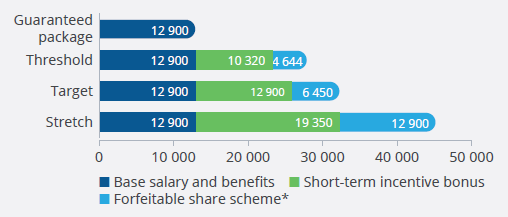
Our forward looking pay-mix and target pay outcomes are market aligned, not overly leveraged with 100% of variable pay being performance based.
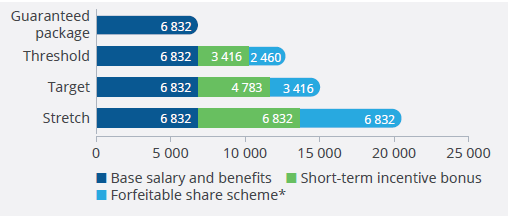
* Conditional share plan vesting in August 2028.
The outturns reflected for the financial period FY25 are indicative of the improved performance of the business.
The performance metrics and weightings for Executive Directors, relating to the STIP for the year ended 31 May 2025, were 20% for individual goals and 80% for financial targets, of which 40% related to normalised EBITDA and 40% to core HEPS, both of which were set based on the 2025 business plan.
For the joint CEOs, achievement of threshold is calculated at 80% of FAR, target at 100% of FAR and a maximum payout at 150% of FAR. For the Financial Director, achievement of threshold is calculated at 50% of FAR, target at 70% of FAR and a maximum payout at 100% of FAR.
The Remuneration Committee set the financial and performance targets for FY25 in line with the approved business plan. The key performance metrics included Normalised EBITDA, core headline earnings per share (HEPS), and NPAT for divisional performance (non-executive management only). The short-term incentive (STI) bonus is directly linked to these metrics, with:
In FY25, the Executive Directors’ focus was directed across the following key areas, with each executive playing a specific role in ensuring effective execution:
These priorities were in addition to their core responsibilities as managers and leaders of the broader business, corporate services and finance functions (see the operating structure and detailed roles that our executives occupy).
Under the leadership of the executive team, Blu Label delivered a strong performance in FY25, despite a challenging trading environment. Strategic decisions and disciplined execution drove results that significantly exceeded financial targets while advancing key strategic priorities.
Collectively, these achievements together with the execution of their broader roles demonstrate the executive team’s ability to drive sustainable growth, deliver strategic outcomes, and strengthen Blu Label’s market position. The business is now beginning to realise the benefits of years of investment, with the market recognising the turnaround in performance and improved future prospects.
The Committee unanimously concluded that the Executive Directors fully achieved their individual KPIs and requirements of their roles for FY25. Accordingly, remuneration related to this portion of the STI scorecard was awarded in full.
| Metrics | Threshold | Target | Stretch* | Actual performance and pro rata payout % achieved |
|
| KPIs (20%) | Individual ** | Pro rata of target | Key strategic outcomes for FY25 including individual performance in role. |
No stretch | All targets relating to individual performance were achieved as outlined in the above narrative. No stretch available for FY25. |
| Payout % of FAR | 16% – CEOs 10% – FD |
20% – CEOs 14% – FD |
No stretch | 20% – CEOs 14% – FD |
|
| Normalised EBITDA (40%) | Group | 20% underperformance against 2025 business plan | 2025 business plan | 20% overperformance against 2025 business plan | Fell short by -7% against 2025 business plan |
| R1.309 billion | R1.636 billion | R1.963 billion | R1.521 billion | ||
| Payout % of FAR | 32% – CEOs 20% – FD |
40% – CEOs 28% – FD |
65% – CEOs 43% – FD |
37.2% – CEOs 25.2% – FD |
|
| Core HEPS (40%) | Group | 20% underperformance against 2025 business plan |
2025 business plan | 20% overperformance against 2025 business plan |
Above stretch. Note Blu Label does not have super stretch outcomes. |
| 94.86 (HEPS) | 118.58 (HEPS) | 142.30 (HEPS) | 270.95 (HEPS) | ||
| Payout % of FAR | 32% – CEOs 20% – FD |
40% – CEOs 28% – FD |
65% – CEOs 43% – FD |
65% – CEOs 43% – FD |
|
| Total payout % of FAR | 80% – CEOs 50% – FD |
100% – Joint CEOs 70% – FD |
150% – Joint CEOs 100% – FD |
Overall outcome between target and stretch = 122.2% – CEOs 82.2% – FD |
| # | The bonus is calculated per metric. The value awarded to financial metrics was a weighted average of scores attained versus target and pro-rated applying linear interpolation. |
| * | Performance in excess of target will not automatically result in paying a bonus in excess of target, and the final award outcome is subject to the Committee’s discretion, further subject to the applicable capping at stretch performance. |
| ** | The maximum award of individual KPIs is at target. Linear interpolation applies between the threshold and the target performance. |
Regarding the above, the overall outcome is between target and stretch, and the associated annual bonuses awarded to the three Executive Directors were R15.16 million each to the joint CEOs, and R5.4 million to the Financial Director, respectively.
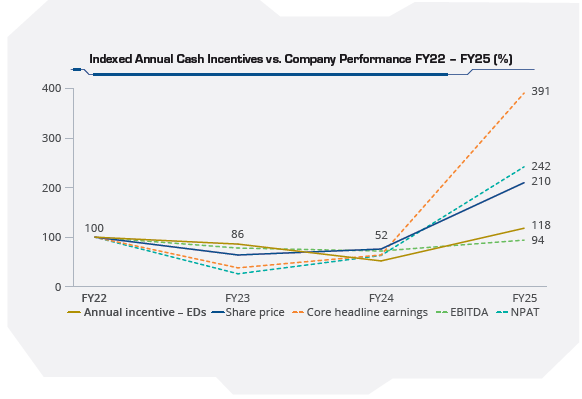
The scorecard and associated outcomes reflected the relatively small miss compared to EBITDA targets and the significant overperformance on core HEPS, maintaining a balance between rewarding strong Group-wide results and areas for divisional improvement. The Committee continually reviews and ensures alignment in outcomes and this is evident in the chart below where our payout trends for the Executive Directors (EDs) as measured by annual cash incentive quantums have closely matched our broad performance trends.
The long-term incentive plan relates to the allocation of shares in 2022. BM Levy, MS Levy and DA Suntup are restricted from trading in the company’s securities as a result of the proposed restructure of the Group. Accordingly, the shares pertaining to the 2022 conditional share plan will vest and settle to them when such restrictions have lapsed. The financial measurement was for the period 1 June 2022 to 31 May 2025, with the following associated scorecard, performance and vesting outcomes.
| Performance metric | Threshold 72% |
Target 100% |
Stretch 140% |
Actual performance outcome |
Actual performance vesting % |
Moderated outcome |
Final vesting % |
|
| Long-term incentive plan (2022 Conditional share plan) | ||||||||
| Growth in core HEPS (30% at target) | 80% of target | CPI + 2% | CPI + 4% | Stretch | 45.00 | Target | 30.00 | |
| Shareholder returns (30% at target) | 80% of target | Performance equal to 5-year SARB nominal long bond rate + 7.5% |
125% of target | Stretch | 45.00 | Stretch | 45.00 | |
| Return on capital employed (20% at target) | ROCE greater than or equal to WACC |
ROCE greater than or equal to WACC + 1% over 3 years |
ROCE greater than or equal to WACC + 2% over 3 years |
Below threshold | 0.00 | Below threshold |
0.00 | |
| Environmental, social and governance (20% at target) | Specific ESGs | Specific ESGs | No stretch | Target | 20.00 | Target | 20.00 | |
| Total vesting % related to performance conditions for the 2022 conditional share plan | 110.00 | 95.00 | ||||||
| – | LTIP is calculated per metric. All metrics will be assessed and vest on a pro rata basis applying linear interpolation except for the ESG assessment, which will be a binary assessment. |
| – | TSR target is a risk-free rate as represented by the five-year SARB nominal bond rate plus an appropriate premium set to ensure fair but realistic targets. |
| – | ROCE = Net operating profit (EBIT)/Capital Employed. Capital Employed = Total Assets – current liabilities (excl. interest-bearing borrowings). |
| BM Levy* | MS Levy* | DA Suntup* | ||
|---|---|---|---|---|
| 2022 initial award value (R’000) at R6.25 | 5 468 | 5 468 | 2 896 | |
| Share price at award date 1 September 2022 (R) | 6.25 | 6.25 | 6.25 | |
| Number of shares awarded | 874 878 | 874 878 | 463 369 | |
| Vesting outcome | 95% | 95% | 95% | |
| Number of shares to vest | 831 134 | 831 134 | 440 201 | |
| 2022 award value excluding share price appreciation (R’000) at R6.25 | 5 195 | 5 195 | 2 751 | |
| Share price at 31 May 2025 (R) | 11.85 | 11.85 | 11.85 | |
| Share price appreciation to 31 May 2025 | 90% | 90% | 90% | |
| Award appreciation to 31 May 2025 (R’000) | 4 654 | 4 654 | 2 465 | |
| 2022 award value as at 31 May 2025 (R’000) at R11.85 | 9 849 | 9 849 | 5 216 |
| * | BM Levy, MS Levy and DA Suntup are restricted from trading in the Company’s securities as a result of the proposed restructure of the Group. Accordingly, the shares pertaining to the 2022 conditional share plan will vest to them when such restrictions have lapsed. |
The growth in core headline earnings per share excluding extraneous contributions amounted to 180.61%, from 96.56 cents to 270.95 cents for the years ended 31 May 2022 and 31 May 2025 respectively. This exceeded the stretch target of CPI + 4% compounded over three years (equivalent to 126.14 cents per share or a growth of 30.63%), primarily due to the Group’s share of Cell C’s profits, which largely reflected the recognition of a deferred tax asset in Cell C. Despite this outcome the Committee considered it prudent to apply downward moderation and align the Core HEPS outcome to a target vesting outcome, reflecting a more balanced view of the business’s performance over the three-year period. This decision took into account the prior year’s downward adjustment of LTI performance targets, which reduced the thresholds for CPI and WACC from a Core HEPS and ROCE perspective, respectively. In addition, executive directors had already been afforded the benefit of a 72% vesting at threshold in the prior year, contingent on the achievement of non-financial performance targets. This outcome resulted in a vesting percentage of 30.00% for the Executive Directors and senior management of both the head office and subsidiary companies.
Blu Label’s share price, calculated using a 20-day VWAP for the years ended 31 May 2025 and 31 May 2022, was R10.61 and R5.04 respectively. This resulted in a TSR of 111% over the three-year period. This was compared to a target level of the five-year SARB nominal long bond rate + 7.5% over the same period, amounting to 59.82%, with the stretch level calculated at 125% of this growth, amounting to 74.78%. The TSR over the three-year period was therefore achieved at a stretch level, resulting in a vesting percentage of 45.00%.
Blu Label’s average WACC over the three year period amounted to 16.08% compared to an average ROCE achieved of 14.65%. The threshold level was therefore not met, resulting in a vesting percentage of nil. The subdued performance of ROCE over the three years ended 31 May 2025 was largely due to a significant level of investment into Cell C, which resulted in the remaining operations forgoing bulk discounts and other related opportunities.
In the above calculation, Blu Label has excluded the financial impact of the recapitalisation transaction of Cell C. Consequently, this calculation reflects the ROCE for the Group, with Cell C excluded, which is consistent with prior years, resulting in a performance outcome that is below threshold and yields no incentive payout for this metric.
The ESG metrics according to which performance was measured in terms of the LTI (over three years – 2023, 2024 and 2025) are set out below and achieved target resulting in a vesting percentage of 20%:
| ESG metrics | Description | Performance outcomes achieved by management |
| Enterprise and supplier development | Increase the number of enterprise and supplier development beneficiaries |
|
| B-BBEE scorecard | Improve B-BBEE scorecard level |
|
| Management control (element of B‑BBEE scorecard) | Support three-year equity plan |
|
| Gender representation | Improve gender parity at senior and top management levels by balancing gender representation |
|
| Social economic development investment |
Support socio-economic development in communities |
|
| Job creation | Create employment opportunities |
|
The downward moderation reduced the overall vesting outcome downwards from 110% to 95%.
The single total figure of remuneration disclosure is based on the Institute of Directors in South Africa (IoDSA) and South African Reward Association (SARA) application guidance on remuneration disclosure in accordance with King IV and presents the remuneration for the Executive Directors and Prescribed Officers of Blu Label. The comparative information has been presented in a manner consistent with the current year’s presentation.
| Executive Directors and prescribed officers remuneration for the year ended 31 May 2025 | Explanatory notes |
BM Levy R'000 |
MS Levy R'000 |
DA Suntup R'000 |
GB Levin3 R'000 |
JS Newman3 R'000 |
Total R000 |
|
|---|---|---|---|---|---|---|---|---|
| Fixed remuneration | 12 404 | 12 404 | 6 569 | 2 819 | 1 371 | 35 567 | ||
| Other benefits | — | — | — | 128 | — | 128 | ||
| 2025 short-term incentive bonus | 1 | 15 157 | 15 157 | 5 400 | — | — | 35 714 | |
| 2022 conditional share plan | 2 | 9 849 | 9 849 | 5 216 | 607 | — | 25 521 | |
| Accrued termination/separation benefits | 3 | — | — | — | 4 108 | 3 403 | 7 511 | |
| Single total figure of remuneration | 37 410 | 37 410 | 17 185 | 7 662 | 4 774 | 104 441 |
| 1. | Based on performance for the financial year ended 31 May 2025, paid in August 2025. |
| 2. | BM Levy, MS Levy and DA Suntup are restricted from trading in the company’s securities as a result of the proposed restructure of the Group. Accordingly, the shares under the 2022 conditional share plan will vest for when such restrictions have lapsed. In terms of the 2022 conditional share plan, 831 134 shares will vest to BM Levy and MS Levy and 440 201 shares to DA Suntup, included in the above table at a 31 May 2025 share price of R11.85. In line with GB Levin’s accrued termination/separation benefits, 107 352 shares at a price of R5.65 vested during the financial year in terms of the 2022 conditional share plan. All other conditional share plan awards relating to GB Levin and JS Newman lapsed on exit. No dividends were applicable to the 2022 conditional share plan. |
| 3. | Agreements were reached wherein it was resolved that GB Levin and JS Newman would exit the Group on 30 November 2024 and 26 August 2024 respectively. |
| Executive Directors and prescribed officers remuneration for the year ended 31 May 2024 | Explanatory notes |
BM Levy R'000 |
MS Levy R'000 |
DA Suntup R'000 |
GB Levin R'000 |
JS Newman R'000 |
Total R000 |
|
| Fixed remuneration | 11 701 | 11 701 | 6 198 | 5 318 | 5 172 | 40 090 | ||
| Other benefits | — | — | 36 | 240 | — | 276 | ||
| 2024 short-term incentive bonus | 1 | 6 649 | 6 649 | 2 406 | 886 | 1 656 | 18 246 | |
| 2021 conditional share plan | 2 | 2 488 | 2 488 | 1 318 | 1 905 | 550 | 8 749 | |
| Single total figure of remuneration | 20 838 | 20 838 | 9 958 | 8 349 | 7 378 | 67 361 |
| 1. | Based on the performance for the period ended 31 May 2024, paid in the following financial year. |
| 2. | Calculated using a share price of R4.30 as at 31 May 2024, vesting at 72% as a result of outcomes over the three-year performance period ended 31 May 2024, to be settled in the following financial year. No dividends were applicable to the 2021 conditional share plan. |
The Remuneration and Nomination Committee is satisfied that the remuneration and reward policy has been complied with for the year under review, insofar as executive management is concerned.
No payments were made on employment termination to any executive management members during the financial year ended 31 May 2025.
| Issue date | Issue price R |
Vesting date |
Awards outstanding as at the beginning of the year |
Number of shares awarded during the year | Awards forfeited during the year |
Awards vested during the year |
Balance as at the end of the year |
Fair value at 31 May 2025 R’000 |
||
|---|---|---|---|---|---|---|---|---|---|---|
| CONDITIONAL SHARE PLAN | ||||||||||
| For the year ended 31 May 2025 | ||||||||||
| Executive Directors | ||||||||||
| BM Levy2 | 6 April 2022 | 6.42 | 31 August 2024 | 803 501 | — | (224 980) | — | 578 521 | 6 855 | |
| BM Levy | 1 September 2022 | 6.25 | 31 August 2025 | 874 878 | — | — | — | 874 878 | 10 367 | |
| BM Levy | 23 October 2023 | 3.22 | 31 August 2026 | 1 817 001 | — | — | — | 1 817 001 | 21 531 | |
| BM Levy3 | 19 November 2024 | 4.93 | 31 August 2027 | — | — | — | — | — | — | |
| 3 495 380 | — | (224 980) | — | 3 270 400 | 38 754 | |||||
| MS Levy2 | 6 April 2022 | 6.42 | 31 August 2024 | 803 501 | — | (224 980) | — | 578 521 | 6 855 | |
| MS Levy | 1 September 2022 | 6.25 | 31 August 2025 | 874 878 | — | — | — | 874 878 | 10 367 | |
| MS Levy | 23 October 2023 | 3.22 | 31 August 2026 | 1 817 001 | — | — | — | 1 817 001 | 21 531 | |
| MS Levy3 | 19 November 2024 | 4.93 | 31 August 2027 | — | — | — | — | — | — | |
| 3 495 380 | — | (224 980) | — | 3 270 400 | 38 754 | |||||
| DA Suntup2 | 6 April 2022 | 6.42 | 31 August 2024 | 425 565 | — | (119 158) | — | 306 407 | 3 631 | |
| DA Suntup | 1 September 2022 | 6.25 | 31 August 2025 | 463 369 | — | — | — | 463 369 | 5 491 | |
| DA Suntup | 23 October 2023 | 3.22 | 31 August 2026 | 962 354 | — | — | — | 962 354 | 11 404 | |
| DA Suntup3 | 19 November 2024 | 4.93 | 31 August 2027 | — | — | — | — | — | — | |
| 1 851 288 | — | (119 158) | — | 1 732 130 | 20 526 | |||||
| Prescribed officers | ||||||||||
| GB Levin1 | 6 April 2022 | 6.42 | 31 August 2024 | 615 300 | — | (172 284) | (443 016) | — | — | |
| GB Levin4 | 1 September 2022 | 6.25 | 31 August 2025 | 198 801 | — | (91 449) | (107 352) | — | — | |
| GB Levin5 | 19 November 2023 | 3.22 | 31 August 2026 | 412 882 | — | (412 882) | — | — | — | |
| 1 226 983 | — | (676 615) | (550 368) | — | — | |||||
| JS Newman1,5 | 6 April 2022 | 6.42 | 31 August 2024 | 177 570 | — | (177 570) | — | — | — | |
| JS Newman5 | 1 September 2022 | 6.25 | 31 August 2025 | 193 344 | — | (193 344) | — | — | — | |
| JS Newman5 | 19 November 2023 | 3.22 | 31 August 2026 | 401 549 | — | (401 549) | — | — | — | |
| 772 463 | — | (772 463) | — | — | — |
| 1 | GB Levin and JS Newman exited the Group on 30 November 2024 and 26 August 2024 respectively. |
| 2 | Although 578 521 shares vested to BM Levy and MS Levy and 306 407 shares vested to DA Suntup during the year, the transfer and/or sale of these shares were restricted due to a closed period in terms of the JSE Listings Requirements. The shares will be transferred once the closed period expires. The shares are included in treasury shares and management has concluded that no agency relationship exists over the shares while these rights are restricted. |
| 3 | The 2024 share awards were not allocated to BM Levy, MS Levy and DA Suntup because they were placed in a closed period. The shares will be awarded once the closed period expires. |
| 4 | The vesting of 107 352 shares formed part of GB Levin’s Accrued Termination/Separation Benefits. |
| 5 | These awards lapsed on exit. |
| Issue date |
Issue price R |
Vesting date |
Awards outstanding as at the beginning of the year |
Number of shares awarded during the year |
Awards forfeited during the year |
Awards vested during the year |
Balance as at the end of the year |
Fair value
at vesting date R’000 |
Fair value at 31 May 2024 R’000 |
||
| FORFEITABLE SHARE SCHEME | |||||||||||
| For the year ended 31 May 2024 | |||||||||||
| Executive Directors | |||||||||||
| BM Levy | 1 September 2020 | 3.20 | 31 August 2023 | 1 520 776 | 138 999 | — | (1 659 775) | — | 5 477 | — | |
| BM Levy | 6 April 2022 | 6.42 | 30 August 2024 | 803 501 | — | — | — | 803 501 | — | 3 455 | |
| BM Levy | 1 September 2022 | 6.25 | 29 August 2025 | 874 878 | — | — | — | 874 878 | — | 3 762 | |
| BM Levy | 23 October 2023 | 3.22 | 31 August 2026 | — | 1 817 001 | — | — | 1 817 001 | — | 7 813 | |
| 3 199 155 | 1 956 000 | — | (1 659 775) | 3 495 380 | 5 477 | 15 030 | |||||
| MS Levy | 1 September 2020 | 3.20 | 31 August 2023 | 1 520 776 | 138 999 | — | (1 659 775) | — | 5 477 | — | |
| MS Levy | 6 April 2022 | 6.42 | 30 August 2024 | 803 501 | — | — | — | 803 501 | — | 3 455 | |
| MS Levy | 1 September 2022 | 6.25 | 29 August 2025 | 874 878 | — | — | — | 874 878 | — | 3 762 | |
| MS Levy | 23 October 2023 | 3.22 | 31 August 2026 | — | 1 817 001 | — | — | 1 817 001 | — | 7 813 | |
| 3 199 155 | 1 956 000 | — | (1 659 775) | 3 495 380 | 5 477 | 15 030 | |||||
| DA Suntup | 1 September 2020 | 3.20 | 31 August 2023 | 805 462 | 73 619 | — | (879 081) | — | 2 901 | — | |
| DA Suntup | 6 April 2022 | 6.42 | 30 August 2024 | 425 565 | — | — | — | 425 565 | — | 1 830 | |
| DA Suntup | 1 September 2022 | 6.25 | 29 August 2025 | 463 369 | — | — | — | 463 369 | — | 1 992 | |
| DA Suntup | 23 October 2023 | 3.22 | 31 August 2026 | — | 962 354 | — | — | 962 354 | — | 4 138 | |
| 1 694 396 | 1 035 973 | — | (879 081) | 1 851 288 | 2 901 | 7 961 | |||||
| Prescribed officers | |||||||||||
| GB Levin | 1 September 2020 | 3.20 | 31 August 2023 | 328 125 | 29 991 | — | (358 116) | — | 1 182 | ||
| GB Levin | 6 April 2022 | 6.42 | 30 August 2024 | 615 300 | — | — | — | 615 300 | — | 2 646 | |
| GB Levin | 1 September 2022 | 6.25 | 29 August 2025 | 198 801 | — | — | — | 198 801 | — | 855 | |
| GB Levin | 23 October 2023 | 3.22 | 31 August 2026 | — | 412 882 | — | — | 412 882 | — | 1 775 | |
| 1 142 226 | 442 873 | — | (358 116) | 1 226 983 | 1 182 | 5 276 | |||||
| JS Newman | 6 April 2022 | 6.42 | 30 August 2024 | 177 570 | — | — | — | 177 570 | — | 764 | |
| JS Newman | 1 September 2022 | 6.25 | 29 August 2025 | 193 344 | — | — | — | 193 344 | — | 831 | |
| JS Newman | 23 October 2023 | 3.22 | 31 August 2026 | — | 401 549 | — | — | 401 549 | — | 1 727 | |
| 370 914 | 401 549 | — | — | 772 463 | — | 3 322 |
| 2025 R’000 |
2024 R’000 |
|||
|---|---|---|---|---|
| Non-Executive Directors | ||||
| LM Nestadt | 2 635 | 2 486 | ||
| H Masondo* | 764 | 507 | ||
| NP Mnxasana | 1 006 | 835 | ||
| JS Mthimunye | 1 439 | 1 358 | ||
| LE Mthimunye | 1 404 | 1 212 | ||
| SJ Vilakazi | 1 476 | 1 223 | ||
| 8 724 | 7 621 |
| * | Appointed 1 August 2023. |
The proposed fees payable to Non-Executive Directors are set out below:
| Current fee 2025 R |
Proposed fee 2026 R |
||
|---|---|---|---|
| Services as Directors | |||
| – Chairman of the Board (per annum) | 2 434 233 | 2 531 602 | |
| – Board members (per annum) | 536 963 | 558 442 | |
| Audit, Risk and Compliance Committee | |||
| – Chairman (per annum) | 486 846 | 506 320 | |
| – Member (per annum) | 300 699 | 312 727 | |
| Remuneration and Nomination Committee | |||
| – Chairman Remuneration (per annum) | 286 380 | 297 835 | |
| – Chairman Nomination (per annum) | 200 466 | 208 485 | |
| – Member (per annum) | 171 828 | 178 701 | |
| Investment Committee | |||
| – Chairman (per annum) | 286 380 | 297 835 | |
| – Member (per annum) | 171 828 | 178 701 | |
| Transformation, Social and Ethics Committee | |||
| – Chairman (per annum) | 171 828 | 178 701 | |
| – Member (per annum) | 107 393 | 111 689 | |
| Ad hoc Committee | |||
| – Chairman (per meeting) | 64 436 | 67 013 | |
| – Member (per meeting) | 38 660 | 40 206 |
Chairman
30 September 2025
BLU Label Unlimited Integrated Annual Report 2025