Independent auditor's report to the shareholders of Blue Label Telecoms Limited
REPORT ON THE AUDIT OF THE CONSOLIDATED FINANCIAL STATEMENTS
Our opinion
In our opinion, except for the possible effects of the matter described in the basis for qualified opinion section of our report, the consolidated financial statements present fairly, in all material respects, the consolidated financial position of Blue Label Telecoms Limited (the Company) and its subsidiaries
(together the Group) as at 31 May 2019, and its consolidated financial performance and its consolidated cash flows for the year then ended in accordance with International Financial Reporting Standards (IFRS) and the requirements of the Companies Act of South Africa.
What we have audited
Blue Label Telecoms Limited's consolidated financial statements set out on comprise:
- the Group statement of financial position as at 31 May 2019;
- the Group income statement for the year then ended;
- the Group statement of comprehensive income for the year then ended;
- the Group statement of changes in equity for the year then ended;
- the Group statement of cash flows for the year then ended; and
- the notes to the financial statements, which include a summary of significant accounting policies.
BASIS FOR QUALIFIED OPINION
The Group holds a 45% interest in Cell C Limited (Cell C) and accounts for this investment as an equity-accounted associate. The Group's interest in Cell C is included in the following financial statement line items within the Group's financial statements:
- share of (losses)/gains from associates and joint ventures (in the Group income statement); and
- investments in and loans to associates and joint ventures (in the Group statement of financial position).
Cell C has a December year-end and management requested them to prepare financial information as at
31 May 2019 for the purposes of preparing the consolidated financial statements of the Group. This financial information was prepared and audited in accordance with the accounting policies of Blue Label Telecoms Limited, and was presented on the going concern basis. The Group's investment in Cell C was included in the consolidated financial statements accordingly.
However, continuation of the adverse trading conditions experienced by Cell C during the year, which included a significant decrease in forecast revenue and lower than anticipated growth in their subscriber base could result in insufficient available cash resources to settle their debts as they come due. For these reasons, the Group's investment in Cell C was impaired to nil (as explained in the key audit matters section below).
In light of the trading circumstances, it is possible that the use of the going concern basis of preparation may not be appropriate for the financial information of Cell C. However, we were not able to obtain sufficient appropriate audit evidence regarding that determination. If the going concern basis of preparation were considered inappropriate, this would result in the remeasurement of assets and liabilities within the financial information of Cell C, with a corresponding net impact on its profit or loss. Such remeasurement would be dependent on which alternate basis of preparation was adopted. Under an alternate basis of preparation, assets and liabilities of Cell C could be impaired, measured at fair value rather than cost, or written off entirely, depending how Cell C planned to recover or settle these assets and liabilities. The possible effect of this matter on the consolidated financial statements would be as follows:
- there could be a material classification misstatement in the Group income statement. The share of losses
from associates and joint ventures as disclosed in note 2.1 may be materially understated in the current
year. However, there would be an equal and opposite overstatement of the impairments on associates and
joint ventures financial statement line item. Therefore, this potential classification misstatement would have
no effect on the Group's loss before taxation;
- the headline earnings per share (HEPS) earnings measure and core HEPS earnings measure would also be
impacted, should the equity-accounted losses and impairment of investment in Cell C materially differ as
explained above; and
- the disclosure of summary financial information of Cell C Limited, presented in note 2.1 to the consolidated
financial statements may be materially misstated.
We conducted our audit in accordance with International Standards on Auditing (ISA). Our responsibilities under those standards are further described in the auditor's responsibilities for the audit of the consolidated financial statements section of our report.
Independence
We are independent of the Group in accordance with the sections 290 and 291 of the Independent Regulatory Board for Auditors' Code of Professional Conduct for Registered Auditors (Revised January 2018), parts 1 and 3 of the Independent Regulatory Board for Auditors' Code of Professional Conduct for Registered Auditors (Revised November 2018) (together the IRBA Codes) and other independence requirements applicable to performing audits of financial statements in South Africa. We have fulfilled our other ethical responsibilities, as applicable, in accordance with the IRBA Codes and in accordance with other ethical requirements applicable to performing audits in South Africa. The IRBA Codes are consistent with the corresponding sections of the International Ethics Standards Board for Accountants' Code of Ethics for Professional Accountants and the International Ethics Standards Board for Accountants' International Code of Ethics for Professional Accountants (including International Independence Standards) respectively.
MATERIAL UNCERTAINTY RELATING TO GOING CONCERN
We draw attention to note 9.2 to the financial statements, which indicates that the Group has evaluated the going concern assumption as at 31 May 2019. One of the Group's significant facilities has been extended to 29 November 2019. A renegotiation for a further extension beyond that date is currently in process. These events or conditions indicate that a material uncertainty exists that may cast significant doubt on the Group's ability to continue as a going concern. Our opinion is not modified in respect of this matter.
OUR AUDIT APPROACH
Overview
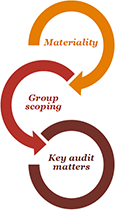 |
Overall Group materiality
- Overall Group materiality: R77 600 000, which represents 0.3% of
consolidated revenue.
|
Group audit scope
- We have identified 17 components which, in our view, require an audit of
their financial information due to their financial significance to the Blue Label Telecoms Group and due to their risk characteristics.
|
Key audit matters
- Assessment of impairment of investment in Cell C.
- Impairment assessment of goodwill arising from business combinations
and impairment assessment of associate investments in Blue Label Mexico
S.A. de C.V. (Blue Label Mexico) and Oxigen Services India Private Limited
(OSI).
|
As part of designing our audit, we determined materiality and assessed the risks of material misstatement
in the consolidated financial statements. In particular, we considered where the directors made subjective
judgements; for example, in respect of significant accounting estimates that involved making assumptions
and considering future events that are inherently uncertain. As in all of our audits, we also addressed the risk
of management override of internal controls, including among other matters, consideration of whether there
was evidence of bias that represented a risk of material misstatement due to fraud.
Materiality
The scope of our audit was influenced by our application of materiality. An audit is designed to obtain
reasonable assurance whether the financial statements are free from material misstatement. Misstatements
may arise due to fraud or error. They are considered material if individually or in aggregate, they could
reasonably be expected to influence the economic decisions of users taken on the basis of the consolidated
financial statements.
Based on our professional judgement, we determined certain quantitative thresholds for materiality,
including the overall group materiality for the consolidated financial statements as a whole as set out in the
table on the following page. These, together with qualitative considerations, helped us to determine the
scope of our audit and the nature, timing and extent of our audit procedures and to evaluate the effect of
misstatements, both individually and in aggregate on the financial statements as a whole.
| Overall group materiality |
|
|
R77 600 000. |
| How we determined it |
|
|
0.3% of consolidated revenue. |
| Rationale for the materiality
benchmark applied |
|
|
Consolidated revenue was selected as the benchmark because, in our view
it is the benchmark against which the performance of the Group can be consistently measured, as it is an indicator of market share which is considered to be the key objective and focus of the Group's business model and users. We chose 0.3% based on our professional judgement and after consideration of the range of quantitative materiality thresholds that we would typically apply when using revenue to compute materiality. The considerations included taking cognisance of the intended users and distribution of the financial statements, the financial covenants held over the Group's debt as well as the inherent risk of the entity. |
How we tailored our Group audit scope
We tailored the scope of our audit in order to perform sufficient work to enable us to provide an opinion on the consolidated financial statements as a whole, taking into account the structure of the Group, the accounting processes and controls, and the industry in which the Group operates.
The Group is made up of five segments, African distribution, International distribution, Mobile, Solutions and Corporate which operate across eight countries and four continents. The Group's main operating subsidiaries and associates are located in South Africa. In establishing the overall audit approach to the Group audit, we determined the type of work that needed to be performed at the local operations by ourselves, as the Group's engagement team, or component auditors from other PwC network firms and firms external to PwC operating under our instructions. The Group's operations vary in size. In total, 17 components were identified to be in full scope for Group reporting purposes due to their financial significance and risk characteristics.
Detailed Group audit instructions were communicated to all components in scope, including Cell C Limited's and Oxigen Services India's component auditors, and comprehensive audit approach and strategy planning meetings were held with all reporting component teams before commencing their respective audits. Throughout the audit, various calls and discussions were held with the teams of the significant components. We also visited the component audit teams responsible for the audit of Cell C Limited as well as Blue Label Mexico.
We assessed the competence, knowledge and experience of the component auditors, including the component auditors of Cell C Limited and Oxigen Services India and evaluated the procedures performed on the significant audit areas to assess the adequacy thereof in pursuit of our audit opinion on the consolidated financial statements.
Where the work was performed by the component auditors, we determined the level of involvement we needed to have in the audit work at these operations to be able to conclude whether sufficient, appropriate audit evidence has been obtained as a basis for our opinion on the consolidated financial statements as a whole.
Analytical procedures were performed over all components not in scope to assess whether any risks exist that would require additional audit procedures.
KEY AUDIT MATTERS
Key audit matters are those matters that, in our professional judgement, were of most significance in our audit of the consolidated financial statements of the current period. These matters were addressed in the context of our audit of the consolidated financial statements as a whole, and in forming our opinion thereon, and we do not provide a separate opinion on these matters. In addition to the matters described in the basis for qualified opinion and material uncertainty relating to going concern sections, we have determined the matters described below to be the key audit matters to be communicated in our report.
| Key audit matter |
|
|
How our audit addressed the key audit matter |
| Assessment of impairment of investment in Cell C Limited |
|
|
|
The Group holds a 45% interest in Cell C and accounts for this investment as an associate in
terms of IAS 28 – Investments in Associates and
Joint Ventures.
During the current year management identified impairment indicators in relation to the investment
in Cell C as at 31 May 2019. These impairment indicators prompted management to perform an impairment assessment. Management appointed
an independent third-party valuation specialist to assess the value of the investment in Cell C. Based
on management's assessment, the investment in
Cell C was impaired to a nil value.
matter of most significance to our current year audit because of the following:
- the financial significance of impairment to the
consolidated financial statements; and
- the impairment assessment required management
to apply judgement in determining the key
assumptions, which include the cash flow
forecasts, discount rate and terminal growth rate.
Refer to note 2.1 for the related disclosures. |
|
|
We obtained management's calculations of the
recoverable amount based on fair value less cost of
disposal. Using this information, and the assistance
of our internal valuations experts, we performed the
following procedures:
- cash flow forecasts were agreed to the approved
budgets and current trading performance of Cell C;
- we tested the reasonability of management's
calculations in determining the discount rate and
corroborated the assumptions applied by
management with third-party sources. We found
the calculations to be within a reasonable range;
- we assessed the reasonability of the terminal
growth rate against long-term GDP growth rate
forecasts for South Africa;
- with the assistance of our internal valuations
experts, we assessed the reasonability of
management's recoverable amount calculation by
flexing certain inputs and assumptions to reflect
independently determined values. We concurred
with management's decision to impair the
investment in Cell C to nil, as this fell within the
reasonable range we had determined; and
- we reviewed the disclosures regarding the
impairment losses in the consolidated financial
statements and noted no material differences.
|
| Impairment assessment of goodwill arising from business combinations and impairment assessment of associate investments in Blue Label Mexico and OSI |
The Group has entered into various business combinations over the last couple of years which resulted in significant goodwill being recognised. The goodwill recognised in these business combinations relates mainly to expected synergies and the ability to introduce new service offerings.
Goodwill is tested annually for impairment or whenever there is an impairment indicator identified by management.
Management's annual goodwill impairment assessments were identified as a matter of most significance to our audit because of the quantum of goodwill as at 31 May 2019, the significant judgement and estimates involved in determining the terminal growth rate, discount rate and forecast cash flows as well as the future market or economic conditions faced by the various businesses within the Group.
Management performed an impairment assessment of the goodwill balance as at 31 May 2019 by performing the following:
- assessing the recoverable amount through
determination of a value-in-use amount and
comparing this to the carrying amount, and if an
impairment was identified, performing a fair value
less costs to sell calculation to determine the
highest recoverable amount;
- the value-in-use for each cash-generating unit
(CGU) was calculated using a discounted cash
flow model; and
- performing a sensitivity analysis over the value-inuse
calculations, by varying the assumptions used
(growth rates, terminal growth rate and the
weighted average cost of capital i.e. discount rate)
to assess the impact on the value-in-use.
Refer to note 4.1 for details of management's
impairment tests and assumptions.
Under IFRS, the Group is required to test the recoverable amount of investments for impairment if there is an indicator of impairment. Management identified an impairment indicator regarding the material investments in OSI and Blue Label Mexico and performed impairment tests as a result.
Management's impairment assessment process relating to the investment in Blue Label Mexico is consistent with the process followed for goodwill as described previously.
For the investment in OSI, management determined that the fair value less cost of disposal is higher than the value-in-use given the uncertainties regarding the future cash flow projections of the Company due to a lack of funding. Management outsourced the valuation of the investment in OSI to qualified independent third-party valuation specialists. Management determined the fair value less cost of disposal by applying a gross revenue multiple, using relevant information generated by similar market transactions that have been concluded by comparable businesses. Key inputs in determining the fair value less cost of disposal are the gross revenue and the revenue multiple applied. Other assumptions are also disclosed in the financial statements.
Refer to note 2.1 for details of management's impairment test and assumptions.
The process of assessing impairment is complex and highly judgemental, and is based on a number of critical assumptions, estimates and judgement including the terminal growth rate, discount rate and forecast cash flows, which are affected by expected future market or economic conditions. Changes in these assumptions may lead to an impairment charge being recognised for the investment in
Blue Label Mexico.
The impairment tests were considered a matter
of most significance to our audit because of the quantum of the goodwill and the investments in Blue Label Mexico and OSI and the complexity involved in the impairment assessments. |
|
|
For material goodwill balances and investment balances, for which the recoverable amounts were determined through value-in-use estimation, our audit procedures included the following:
- we evaluated management's assessment of the
identification of the Group's CGUs and obtained
the relevant impairment assessments performed
by management for these CGUs (including the
CGUs within Blue Label Mexico);
- we assessed the reasonability of management's
cash flow forecasts through discussions with
management regarding the process followed
to develop the budgets, forecasts and the
assumptions utilised. We also compared the prior
year budgets to the current year actual results to
understand the efficacy of management's
budgeting process and found that the budgeting
inputs were reasonable;
- we evaluated whether the assumptions used, such
as working capital and capital expenditure, had
been determined and applied consistently across
the CGUs;
- we agreed the budgets to the latest Boardapproved
budgets. The Board-approved budgets
cover a period of five years and the forecasts for
the purpose of the value-in-use calculations also
covered a period of five years;
- we assessed the mathematical accuracy of the
valuations performed by management as well as
the appropriateness of the methods used for the
valuations and found no exceptions;
- we made use of our internal valuations experts to
independently calculate discount rates taking into
account independently obtained data such as the
cost of debt, risk free rates in the market, market
risk premiums, country risk premium, specific risk
premium, debt/equity ratios as well as the beta of
comparable companies. This was compared to the
discount rates used by management. Where
differences were noted, we discussed these with
management and evaluated whether in those
instances the different rates would have resulted in
an impairment. We found the discount rates used
by management to be within acceptable ranges of
our independent calculations;
- the terminal growth rates were compared to
forecast industry trends and to independent
sources for similar operations;
- we further made use of our internal valuations
experts to assess the approaches adopted by
management in the valuation models for both
goodwill and the investments in Blue Label Mexico
and found that the approaches were in line with
market practice and the applicable requirements
of IAS 36 – Impairment of Assets; and
- we performed independent sensitivity calculations
on the impairment assessments, to determine the
degree by which the key assumptions needed to
change in order to trigger an impairment. We
discussed these with management and based on
the evidence obtained we accepted management's
conclusion that the key assumptions, estimates
and judgements applied in the models were
reasonable.
For the investment in OSI, for which the recoverable
amount was determined through fair value less costs
of disposal estimation, our audit procedures included
the following:
- we evaluated the reasonableness of management's
use of the fair value less cost of disposal as the
appropriate recoverable amount in terms of IAS 36
– Impairment of Assets, and found this to be
appropriate; and
- we made use of our internal valuations experts to
identify and assess the reasonableness of the
revenue multiple applied with reference to similar
transactions, and evaluated key assumptions
utilised by management in their valuation. We
found the multiple to be reasonable and key
assumptions to be appropriately applied.
|
OTHER INFORMATION
The directors are responsible for the other information. The other information comprises the information included in the documents titled "Blue Label Telecoms 2019 annual financial statements" and "Blue Label Telecoms Limited annual financial statements for the year ended 31 May 2019", which include the directors' report, the Audit Risk and Compliance Committee's report and the declaration by the Company Secretary as required by the Companies Act of South Africa, which we obtained prior to the date of this auditor's report, and the other sections of the document titled "Blue Label Telecoms integrated annual report 2019", which is expected to be made available to us after that date. The other information does not include the consolidated and separate financial statements and our auditor's report thereon.
Our opinion on the consolidated financial statements does not cover the other information and we do not express an audit opinion or any form of assurance conclusion thereon.
In connection with our audit of the consolidated financial statements, our responsibility is to read the other information identified above and, in doing so, consider whether the other information is materially inconsistent with the consolidated financial statements or our knowledge obtained in the audit, or otherwise appears to be materially misstated.
If, based on the work we have performed on the other information that we obtained prior to the date of this auditor's report, we conclude that there is a material misstatement of this other information, we are required to report that fact. As described in the basis for qualified opinion section above, we were unable to obtain sufficient appropriate evidence on the accuracy of the financial information for Cell C. Accordingly, we are unable to conclude whether or not the other information is materially misstated with respect to this matter.
RESPONSIBILITIES OF THE DIRECTORS FOR THE CONSOLIDATED FINANCIAL STATEMENTS
The directors are responsible for the preparation and fair presentation of the consolidated financial statements in accordance with IFRS and the requirements of the Companies Act of South Africa, and for such internal control as the directors determine is necessary to enable the preparation of consolidated financial statements that are free from material misstatement, whether due to fraud or error.
In preparing the consolidated financial statements, the directors are responsible for assessing the Group's ability to continue as a going concern, disclosing, as applicable, matters related to going concern and using the going concern basis of accounting unless the directors either intend to liquidate the Group or to cease operations, or have no realistic alternative but to do so.
AUDITOR'S RESPONSIBILITIES FOR THE AUDIT OF THE CONSOLIDATED FINANCIAL STATEMENTS
Our objectives are to obtain reasonable assurance about whether the consolidated financial statements as a whole are free from material misstatement, whether due to fraud or error, and to issue an auditor's report that includes our opinion. Reasonable assurance is a high level of assurance, but is not a guarantee that an audit conducted in accordance with ISA will always detect a material misstatement when it exists. Misstatements can arise from fraud or error and are considered material if, individually or in the aggregate, they could reasonably be expected to influence the economic decisions of users taken on the basis of these consolidated financial statements.
As part of an audit in accordance with ISA, we exercise professional judgement and maintain professional scepticism throughout the audit. We also:
- Identify and assess the risks of material misstatement of the consolidated financial statements, whether
due to fraud or error, design and perform audit procedures responsive to those risks, and obtain audit
evidence that is sufficient and appropriate to provide a basis for our opinion. The risk of not detecting a
material misstatement resulting from fraud is higher than for one resulting from error, as fraud may involve
collusion, forgery, intentional omissions, misrepresentations or the override of internal control.
- Obtain an understanding of internal control relevant to the audit in order to design audit procedures that
are appropriate in the circumstances, but not for the purpose of expressing an opinion on the effectiveness
of the Group's internal control.
- Evaluate the appropriateness of accounting policies used and the reasonableness of accounting estimates
and related disclosures made by the directors.
- Conclude on the appropriateness of the directors' use of the going concern basis of accounting and, based
on the audit evidence obtained, whether a material uncertainty exists related to events or conditions that
may cast significant doubt on the Group's ability to continue as a going concern. If we conclude that a
material uncertainty exists, we are required to draw attention in our auditor's report to the related
disclosures in the consolidated financial statements or, if such disclosures are inadequate, to modify our
opinion. Our conclusions are based on the audit evidence obtained up to the date of our auditor's report.
However, future events or conditions may cause the Group to cease to continue as a going concern.
- Evaluate the overall presentation, structure and content of the consolidated financial statements, including
the disclosures, and whether the consolidated financial statements represent the underlying transactions
and events in a manner that achieves fair presentation.
- Obtain sufficient appropriate audit evidence regarding the financial information of the entities or business
activities within the Group to express an opinion on the consolidated financial statements. We are
responsible for the direction, supervision and performance of the Group audit. We remain solely
responsible for our audit opinion.
We communicate with the directors regarding, among other matters, the planned scope and timing of the audit and significant audit findings, including any significant deficiencies in internal control that we identify during our audit.
We also provide the directors with a statement that we have complied with relevant ethical requirements regarding independence, and to communicate with them all relationships and other matters that may reasonably be thought to bear on our independence, and where applicable, related safeguards.
From the matters communicated with the directors, we determine those matters that were of most significance in the audit of the consolidated financial statements of the current period and are therefore the key audit matters. We describe these matters in our auditor's report unless law or regulation precludes public disclosure about the matter or when, in extremely rare circumstances, we determine that a matter should not be communicated in our report because the adverse consequences of doing so would reasonably be expected to outweigh the public interest benefits of such communication.
REPORT ON OTHER LEGAL AND REGULATORY REQUIREMENTS
In terms of the IRBA Rule published in Government Gazette Number 39475 dated 4 December 2015, we report that PricewaterhouseCoopers Inc. has been the auditor of Blue Label Telecoms Limited for 15 years.
Pricewaterhouse Coopers Inc.
Director: Deon Storm
Registered Auditor
Waterfall
26 September 2019