|
Currently viewing: Operational overview / Next: Value added statement OPERATIONAL OVERVIEW
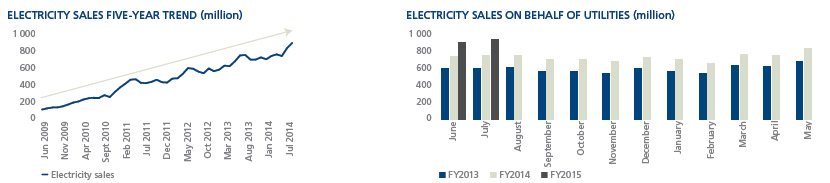
This business segment distributes prepaid products and transactional services to the South African wholesale and retail markets, covering a diverse distribution footprint, and reaching all LSM groups. The product range now includes four categories of goods and services – prepaid airtime and starter packs, prepaid electricity, event and transport ticketing, financial services and merchant acquiring. The segment contributes 98% to Group revenue. OVERVIEW As the leading distributor of prepaid airtime and prepaid electricity in South Africa and with a growing suite of products and services, this segment is well positioned to supply its customers with those needs. Distribution capabilities range from independent shops, petroleum forecourts, spaza shops and Mom & Pop stores, through to the multi-channel retail chains. In this way, the Group enables consumers to interact and transact on an equal footing. Critical to growth is the expansion of supply to targeted rural and urban market, aligned to the Group’s strategy of managing “the last mile” of the distribution channel. This is aimed at deepening penetration in their respective markets where, over the past year, further investment has been made. The informal sector generates approximately 85% of SA Distribution’s revenue. Services to rural areas are via an expanding fleet of trucks accompanied by foot soldiers. In this direct distribution model, innovative transactions and incentives can be implemented, value is added directly to the consumer and, as a consequence, solid relationships are established with merchants. The remaining 15% of revenue is derived from the formal sector. In respect of retailers, the Group manages the front-end of their businesses, thereby ensuring that the full suite of Blue Label products and services is available to consumers at these outlets. Distribution to urban merchants continues to be expedited through the Group’s proprietary technology platforms. The trend in consumers opting for “PINless top-ups” as an alternative redemption method for prepaid airtime, continues to escalate. During the past year sales by these methods increased from R997 million to R1.7 billion. Blue Label’s widespread network of point-of-sale presence enables it to reach out to consumers every day and everywhere across South Africa, in offering its categories of products and services. Prepaid airtime and starter packs Prepaid airtime and starter pack sales continue to generate the majority of this segment’s profitability. Benefit starter packs catering for pregnant women, insurance cover for accidental death and funeral plans and value-adding bundling with DVDs, such as the Nelson Mandela Commemorative, are examples of differentiators between the Group and traditional distributors of prepaid airtime. The importance of a targeted approach is that starter packs are distributed to market in a strategic manner which maximises activation and in turn the resultant annuity revenue stream. The introduction of low-cost POS terminals, branded “business in a box” and “Rechaja Mo” (recharge here) continues to gain momentum. Both devices were developed for merchants and vendors in the rural market, in pursuance of managing “the last mile” of the distribution channel. Another innovation, “Chat 4 Change”, has been enabled across all platforms. This variable denominational airtime top-up mechanism offers customers a quick and simple choice of utilising spare change on a transaction to purchase airtime to that value rather than being bound by the fixed denominations offered by the networks. The wholesale strategy remains robust with a solid trader base of approximately 1 000 wholesalers who, in this physical mass environment, supply over 100 000 retailers with some 80 million bulk print airtime vouchers per month. As is customary when opportunities avail themselves, bulk purchase transactions are concluded with the networks at favourable discount rates. The Prepaid Company (TPC) is the leading distributor of prepaid products for all the major network operators. TPC also facilitates, manages and maintains the distribution of all virtual products and starter packs. These services are supported by proven proprietary technology, which ensures purchasing efficiency, managing the distribution channel and inventory control. Relationships with each of the network operators are key to the success of this business. TPC is responsible for supplier agreements and procurement for the Group, wholesale and community sales, starter packs and handsets and facilitating its merchants with bulk airtime printing capabilities. Group Treasury falls under the ambit of TPC. Blue Label Distribution (BLD) distributes products through POS terminals, integrated gateways, vending machines, touch screens and RICA devices. BLD is supported by eight sales branches across the country situated in Sandton, Cape Town, Durban, Port Elizabeth, Bloemfontein, East London, Nelspruit and Polokwane. Each branch performs the functions of sales, customer service and field support. A 24/7 customer call centre for merchant and UniPIN support, as well as airtime and electricity sales, strengthens their efficient levels of service. The Post Paid Company (TPPC) distributes hybrid top-up postpaid airtime and data contracts on behalf of all major South African cellular networks. TPPC also distributes handsets, tablets and various insurance products, including handset cover and death benefits. TPPC’s distribution channels in South Africa include outbound call centres, various major banks, micro-lenders, retailers, schools (via an online portal) and companies wishing to offer TPPC’s services to their employees. RMCS is an enhanced service provider of cellular products and services engaged in the supply of telecommunication products and services, content, data and allied activities via both physical and virtual mediums. The physical presence is in the form of stores and the virtual offering is in the form of an “Over the Air” cellular application which enables retailers, credit providers and consumers to communicate and transact over their mobile devices. The recent acquisition of RMCS affords the Group access to new channels for the distribution of both RMCS and its products and services. Prepaid electricity The supply of prepaid electricity tokens on behalf of the utilities is based on the same model as that of prepaid airtime. Blue Label has been vending prepaid electricity for the past 10 years and is a leading distributor in this field. The growth in prepaid electricity commissions earned is due to a combination of factors:
Potential additional drivers to growth include smart meter installation projects ramping up at municipalities across the country, as well as the increasing revenue collection campaigns at municipalities. In respect of the sale of prepaid electricity, the Group acts as an agent and not as a principal. Therefore only commissions earned and not the face value of electricity sales are included in reported revenue. Turnover generated on behalf of the utilities increased to R8.8 billion in the current year (2013: R7.2 billion). The commission earned thereon equated to R133 million (2013: R113 million). Cigicell distributes virtual prepaid airtime and electricity through a broad network of channels, including formal and informal retail and electronic banking environments. It is responsible for managing the numerous distribution contracts with utilities in respect of the distribution of prepaid electricity tokens.
Event and transport ticketing TicketPros, South Africa’s most recent ticketing solution, provides event and transport ticketing, including sport, travel, entertainment, lifestyle and expos. It also offers the convenience of a variety of ticketing types, such as NFC, card, home-print, secure-print and till-print. TicketPros intelligently assesses accumulated data with a view to understanding consumer behaviour. This is achieved by combining information gained via loyalty programmes and reward cards. This enables promoters to understand consumer behaviour and buying patterns and ultimately delivers a unique experience to consumers, while enhancing marketing channels for sponsors and brand owners.
During the year an increasing number of sports unions, event managers and short- and long-distance bus and coach transport companies went live with TicketPros, enabling an increasing number of Blu Approved retail outlets to add ticketing to their product range on offer. Financial services A growing number of financial services are available, including bill payments, merchant acquiring and money transfers. Bill payments enable consumers to make payments for numerous services at Blu Approved terminals. These services include TV licences, Multichoice subscriptions, Telkom landlines, traffic fines, municipal rates and taxes, electricity accounts, funeral policies, education and school fees, furniture accounts and the National Lottery. In an arrangement with the merchant acquirer, MasterCard, and the SA commercial bank, ABSA, BLD’s devices will enable the acceptance of credit and debit card acquiring transactions. It is expected that up to 22 000 of these devices will be deployed in the initial phase. Blu Approved
Technology The technology division is housed in this segment as the bulk of its functions and services are interdependent in the distribution of airtime, starter packs and electricity. Through the proprietary AEON and AMS systems, as well as the banking and financial services grade Postilion platform, the Group’s capability as a neutral aggregator is entrenched in connecting to mobile networks, utilities, banks, retailers, petroleum companies and the point-of-sale devices. The technology division supports in excess of 400 million transactions per month. Approximately 80 million bulk print vouchers are distributed per month. Transaction Junction provides the Group’s EFT capabilities. Following the commissioning of enhanced infrastructure in the prior year, critical for Disaster Recovery and Business Continuity planning, the physical infrastructure consolidation project was completed during the current year. Further improvements will be implemented on an ongoing basis in order to enhance the Disaster Recovery solution. The South African Distribution segment’s contribution to core net profit equated to R559 million (2013: R571 million).
The strategy of the International Distribution segment is to pursue services across its global footprint, by systematically rolling out points of presence, in a replication of the proven South African business model. BLUE LABEL MEXICO The business in Mexico encapsulates a number of agreements with key participants in the sales and distribution channels, including the major network operator, Telcel, and the world’s largest bakery, Grupo Bimbo, a joint 45.57% shareholder with Blue Label in BLM. Main products on offer include PINless recharge, bill payments and cash collections. Following agreements concluded in September 2013 with Banamex, the second-largest commercial bank in Mexico, and with the merchant acquirer Visa, devices at BLM’s merchant base are being upgraded in order to support and facilitate the electronic payments though acquiring debit and credit card transactions. More recently, agreements have been concluded for the distribution of food vouchers through BLM’s technology platform. The project to expand the distribution network across Mexico, by initially deploying up to 123 000 POS devices, progresses steadily with some 92 000 terminals currently installed. Blue Label’s share of losses for the year amounted to R60.8 million (2013: R51.1 million loss), consistent with the developmental stage of this market, the sluggish economy and government’s fiscal reforms.
UKASH Ukash is the trading name of Smart Voucher Limited, which is authorised and regulated by the Financial Conduct Authority in the United Kingdom as an electronic money institution. Ukash is a Global e-Money Network which provides an internationally recognised e-commerce cash payment solution. Consumers around the world are able to exchange cash at retail outlets, including shops, petrol forecourts, ATMs, kiosks or online, for a unique 19-digit code. Consumers can then spend their Ukash code to pay at thousands of websites or load their prepaid cards and e-wallets, in a safe, secure and convenient manner. During the year, the focus was on diversification into new products, with the launching of Money Transfer in association with Moneygram® and the Ukash Prepaid MasterCard® product. In a partnership with Birmingham City Football Club, fans are now able to purchase match tickets and club merchandise using Ukash. Just after year-end the Ukash Travel Money Card was brought to market.
Year-on-year organic growth resulted in revenue increasing by 14% as measured in sterling. The Group’s 17.25% share of profit equated to R14.1 million (2013: R7.3 million). OXIGEN SERVICES INDIA In reaching out to India’s unbanked and rural communities, Oxigen continues building a valuable distribution network and cash-out infrastructure. Currently Oxigen supports about 35 million transactions per month, principally through kiosk, POS and e-wallet banking.
A recent historic tie-up with the National Payments Corporation of India has enabled Oxigen to become India’s first non-banked wallet to be approved by the Reserve Bank of India to provide direct connectivity to more than 60 banks on the national switch of the NPCI, through its immediate payment service. As a consequence, mobile payment remittances are emerging as a new growth driver in Oxigen, with the value of domestic and international money transfers and deposits already exceeding USD2.5 million per day. In alignment with government’s financial inclusion agenda, the Reserve Bank of India has initiated a cash-out pilot project to demonstrate that Oxigen’s technology and wallet support cash-out transactions in the rural parts of India. Blue Label’s share of losses for the year equated to R3.3 million (2013: R0.6 million loss).
The segment provides a complete mobile ecosystem for customers requiring mobility to their traditional channels, e.g. smartphone, WAP, JAVA, SMS and USSD. Mobile’s ecosystem allows for the rapid roll-out of mobile-mediated sales, financial services, banking, couponing, loyalty, rewards, ticketing, transport, NFC, media advertising, gaming and location-based services. The technologies and products developed enable our customers to reach their customers, regardless of what type of phone or mobile operator is being utilised. Core net profit contribution for this segment amounted to R24.9 million (2013: R24.8 million). This segment comprises the following operating entities: CELLFIND Cellfind is the Group’s WASP, aggregator and location-based services provider, predominantly deriving annuity income from location-based services delivered to the major mobile network operators. Its offerings include the aggregation and bulk distribution of SMSs; mobile payslips (miPayslip and miStatement); and LBS (Look4Me, Look4Help, MTN WhereRU, MTN 2MyAid and ER24 IdMe). In partnership with TeleCommunicationSystems, LBS products are offered into the rest of Africa. Through the wholly owned subsidiary, Panacea Mobile, enhanced bulk SMS aggregation capabilities and intelligent distribution are delivered. This segment processes approximately 175 million SMSs per month. BLUE LABEL ENGAGE Blue Label Engage designs and operates customer engagement, loyalty and reward programmes. NFC and other contactless technologies bridge the gap between mobile and physical transactional services. Monitoring the usage of a card enables its user to be rewarded and affords the opportunity of cross-selling and up-selling products and services. In respect of entertainment, fans are able to join supporter groups, providing them with ticketing, stadium access, concessionary management, partner and programme activations and the like. These ultimately enhance a supporter’s experience. The Group provides spectator sport programmes for rugby’s Blue Bulls, as well as for Cricket SA. Sponsorship of the Proteas T20 squad, with naming rights, has granted us access to millions of cricket fans, thousands of whom have joined the “Love Cricket” brand of CSA, which is a shared business venture between BLE and CSA. In February 2014, in a world first for cricket, South African fans started to use NFC technology to enhance their ticketing, loyalty and reward experiences. VIAMEDIA Viamedia is a mobile content and value-added services provider. Its technology platform connects to all South African mobile networks, offering the best of breed in mobile services. These include mobile terminate and originate and premium rated SMSs, online billing, multimedia messaging, WAP and web services, unstructured supplementary services data and interactive voice response. Viamedia offers its partners the ability to sell mobile entertainment, information and communication services to consumers through a variety of media and technology channels.
The segment specialises in the provision of data and analytical support services and the marketing of cellular and other products and services through call centres. This segment houses CNS, Velociti and Blue Label call centres as well as Datacision, Forensic Intelligence Data Solutions and Blue Label Data Solutions. BLDS is a founding member of the Direct Marketing Association of South Africa and remains accredited to the Association. Core net profit contribution from this segment was R12.5 million (2013: R13.2 million). Our data bases have continued to expand and can now touch over 55 million consumers. Growth was mainly derived from a consistent focus on products and services related to data and its analytics, such as fraud and debt management solutions, automated voice messaging, consumer analytics and field lead generation. The call centre business remains challenging across all measures. The remedial efforts taken in the year resulted in major improvements, while cost reductions and new business development will continue to be focal points in the year ahead. |
||||||||||||||||||||||||||||||||||||||||||||||||




 Having commenced operations 10 years ago as a prepaid airtime distributor, Oxigen’s strategic shift into payment solutions and financial services continues to take hold. Growth is underpinned by partnerships with India’s major banks, such as the State Bank of India and ICICI Bank, for the banking correspondent business, also known as kiosk banking.

Useful links |
E-BOOKUse this link to view our Integrated Report as an E-Book
|
DownloadsThis report is available to download as a full document and in sections. |
| Blue Label Integrated annual report 2014 |