Currently viewing: Stakeholder relations / Next: Remuneration report
STAKEHOLDER RELATIONS
The Board has ultimate accountability for stakeholder strategy and
engagement, recognising that developing and nurturing dialogue
with key stakeholders is a driver of business sustainability. The
responsibility for satisfactory stakeholder relationships vests with
every employee in the Group, as we recognise that a good
reputation is a competitive advantage.
GOVERNING STAKEHOLDER RELATIONSHIPS
The nature of the relationships with stakeholders can
affect the Group’s reputation and therefore ability to
create value. We approach stakeholders with trust
and respect and look to them for the same mutual
good faith. A broad range of internal and external
stakeholders with a material or potential interest in,
or who are affected by us, has been identified.
We recognise the importance of identifying issues of
a shared interest, but also value the opportunity for
engagement, as it provides a unique insight into the
expectations of each stakeholder group. We apply a
measured approach to interacting with and responding
to stakeholders. A stakeholder engagement programme
has been formalised for the most relevant stakeholder
groupings. This process takes into account the impact
that each stakeholder group may have on our business,
while the frequency and form of engagement is aligned
to its estimated impact.
Some of the initiatives and methods used in the
process of engaging with stakeholders comprise
face-to-face formal or informal, individual or group
meetings (including the AGM), media and stock
exchange news announcements, presentations,
roadshows, conference calls, the Blue Label website
(www.bluelabeltelecoms.co.za), investor site and
trade visits. We also rely on the results of perception
studies, reputation audits, whistle-blowing facilities
and formal grievance mechanisms, financial and
sustainability reports. In addition, we initiate
newsletters, circulars and e-mail updates, regular
customer, business partner and supplier meetings,
below- and above-the-line advertising and
marketing across various channels, formal
consultations and audit processes, and host
management and sales conferences. Dialogue,
review and feedback is encouraged wherever
possible, which in turn is presented to Exco and/or
committees, such as the Social, Ethics and
Transformation Committee, for consideration and/or further action.
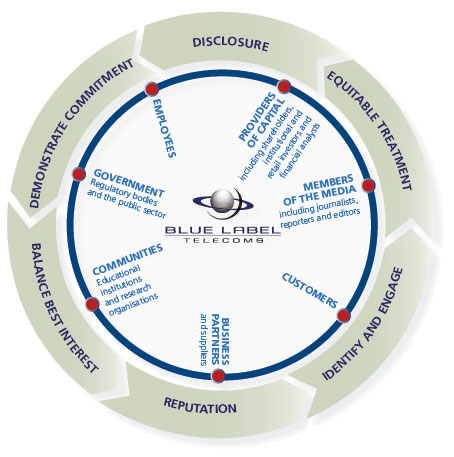
In terms of King III and the Board’s requirement
to address stakeholder management, the Board’s
approach to stakeholder engagement includes:
 |
identifying and engaging with important
stakeholders; |
|
appreciating that stakeholder perceptions affect
reputation, and therefore manage reputation risk; |
|
delegating to management the responsibility to
deal with stakeholder relationships; |
|
overseeing the mechanisms and processes for the
constructive engagement of stakeholders; |
|
disclosing stakeholder engagement in the
integrated annual report; |
|
striving to achieve a balance of stakeholders’
legitimate expectations in the best interests of the
Company; and |
|
ensuring equitable treatment of shareholders. |
Ultimately, our stakeholder engagement programme
supports our efforts to be a successful, stable and
ethical company contributing to the economic growth
of the communities in which we operate.
| |
Stakeholder group |
|
Nature of engagement |
|
Method of engagement |
|
Dialogue process and outcomes |
|
 |
|
|
|
|
|
|
|
|
| |
Employees |
|
Ongoing communication with employees covers matters of a strategic, fi nancial
and operational nature, including new developments, product launches, health and
safety initiatives, internal policies and practices such as the ethics hotline, new
products, competitions, business initiatives, charitable initiatives, human resource
matters and staff-related news and regulatory and compliance matters.
Blue Label also holds an annual conference attended by Senior Management.
The purpose of the conference is to obtain input and feedback from attendees on
strategic and common operational matters. Most companies host their own
management and strategy conference, held at least once a year. |
|
Staff meetings, newsletters, posters, e-mail, staff
notices posted on notice boards, in the canteen and in
lifts, lunch and coffee station discussions, management
presentations and briefings of strategy updates,
financial and personal performance.
Other methods include wellness days, a carnival day,
blood donor drives, health campaigns, the winter
Olympics, the year-end awards ceremony, social events
with employees, customers and service providers.
More details are provided in the human capital section
on page 88.
Keynote speakers from industry, discussion groups,
breakaway sessions, motivational speakers, team
building exercises and industrial theatre performances. |
|
Innovation in our entrepreneurial environment is
nurtured, while motivation and values are reinforced
in a safe and rewarding environment. Staff
performance is reviewed annually with the intention
of measuring performance and reviewing salaries.
There is a forum to which staff may make
recommendations and/or requests. |
|
| |
Providers of capital,
including
shareholders,
institutional and
retail investors and financial analysts |
|
Engagement includes ongoing and/or ad hoc meetings with top management
involving presentations covering fi nancial performance of the Group, overview of
strategic direction and discussion of the investment proposition.
Visits to the Demonstration Centre and warehouse at No 75 Grayston Drive and
visits to our customers’ sites are arranged on request.
Individuals from this stakeholder group and their contact details are registered on
the Blue Label investor database. |
|
Integrated annual report, interim report and AGM.
The highlights of the interim and year-end results are
published in the press as a short-form advertisement.
SENS announcements via the JSE.
Face-to-face meetings, group meetings, teleconference
and video-conference calls.
Speaker and presenter at investor conferences, JSE
Showcases and other workshops.
Investor alerts are e-mailed after website registration.
See detailed typical annual calendar rogramme on
page 56. |
|
To address this stakeholder group’s request to
increase its understanding of the business model,
as well as products and services, management is
available to take meetings and conference calls
throughout the year, subject to close period dates.
Presentations and webcasts are posted on the
Company’s website (www.bluelabeltelecoms.co.za).
The Company’s Demonstration Centre, situated at No
75 Grayston Drive, Sandton, provides an audio-visual
overview of the Group and its activities, while
simulating transactions on various types of terminals.
A warehouse, also situated at No 75 Grayston Drive,
can be visited by prior arrangement. |
|
| |
Members of the
media, including
journalists,
reporters and
editors |
|
Announcements of activities and events in the Group, including the release of
fi nancial information twice a year, are communicated timeously to the fi nancial
media, trade press and other interested media registered on the Blue Label media
database.
Briefi ngs to media are held at the interim and full-year results, followed by Q&A.
One-on-one interviews are conducted on radio, TV and with print and on-line
journalists and editors. |
|
News releases are distributed to media and news
services both locally and overseas, as per a database
maintained by the Company.
Print and on-line media monitoring is outsourced and
reports of coverage are received and distributed daily
among business segments, as appropriate. |
|
To raise this stakeholder group’s interest and
awareness of the scope of business, products and
services, a number of media site and trade visits,
including the Demonstration Centre, were held
during the year.
A number of interviews with Senior Management
resulted in articles published in the press, with subjects
covering financial performance, financial services
products and distribution to the informal sector. |
|
ENGAGEMENT PROGRAMME
A typical investor relations, employee and media engagement programme of activities for a calendar year includes:
| |
|
January |
February |
March |
April |
May |
June |
July |
August |
September |
October |
November |
December |
| Financial year-end |
|
|
|
|
|
✓ |
|
|
|
|
|
|
|
| Results announcement for the year ended
31 May released on SENS and posted to website |
|
|
|
|
|
|
|
|
✓ |
|
|
|
|
| Dividend declared |
|
|
|
|
|
|
|
|
✓ |
|
|
|
|
| Dividend paid |
|
|
|
|
|
|
|
|
|
✓ |
|
|
|
| Results presentation to market – Johannesburg and
webcast, materials posted to website |
|
|
✓ |
|
|
|
|
|
✓ |
|
|
|
|
| Results roadshow to institutional investors and sell side
analysts – SA |
|
|
✓ |
|
|
|
|
|
✓ |
|
|
|
|
| Results roadshow to institutional investors and sell side
analysts – UK and USA |
|
|
|
✓ |
|
|
|
|
|
✓ |
|
|
|
| Integrated annual report and notice of AGM posted to
website and shareholders |
|
|
|
|
|
|
|
|
|
|
✓ |
|
|
| AGM |
|
|
|
|
|
|
|
|
|
|
|
✓ |
|
| Half-year-end |
|
|
|
|
|
|
|
|
|
|
|
✓ |
|
| Interim results announcement for the six months ended
30 November released on SENS and posted to website |
|
|
✓ |
|
|
|
|
|
|
|
|
|
|
|
|
January |
February |
March |
April |
May |
June |
July |
August |
September |
October |
November |
December |
| Conference call by management to update market on
specific activities/operations |
|
|
|
|
|
✓ |
|
|
|
|
|
✓ |
|
| Participation at investor conferences |
|
|
|
✓ |
✓ |
✓ |
|
|
|
✓ |
✓ |
✓ |
|
| Site visits |
|
✓ |
✓ |
✓ |
✓ |
✓ |
✓ |
✓ |
✓ |
✓ |
✓ |
✓ |
✓ |
| Management engages investors, analysts, media |
|
|
|
✓ |
✓ |
✓ |
|
|
|
✓ |
✓ |
✓ |
|
| Close periods per JSE |
|
✓ |
✓ |
|
|
|
✓ |
✓ |
✓ |
|
|
|
✓ |
| Ad hoc announcements disclosed through SENS |
|
✓ |
✓ |
✓ |
✓ |
✓ |
✓ |
✓ |
✓ |
✓ |
✓ |
✓ |
✓ |
| Announcements posted to website and distributed to
global database of stakeholders |
|
✓ |
✓ |
✓ |
✓ |
✓ |
✓ |
✓ |
✓ |
✓ |
✓ |
✓ |
✓ |
| Global database of stakeholders maintained
by Investor Relations |
|
✓ |
✓ |
✓ |
✓ |
✓ |
✓ |
✓ |
✓ |
✓ |
✓ |
✓ |
✓ |
| Guide market analysts into half- and year-end results |
|
|
|
|
|
✓ |
|
|
|
|
|
✓ |
|
| Media |
|
✓ |
✓ |
✓ |
✓ |
✓ |
✓ |
✓ |
✓ |
✓ |
✓ |
✓ |
✓ |
| Employees |
|
✓ |
✓ |
✓ |
✓ |
✓ |
✓ |
✓ |
✓ |
✓ |
✓ |
✓ |
✓ |
| |
Stakeholder group |
|
Nature of engagement |
|
Method of engagement |
|
Dialogue process and outcomes |
|
|
|
|
|
|
|
|
|
|
| |
Customers |
|
The Group’s customer base comprises corporate clients, chain stores, large
independent retail clients, wholesale/cash-and-carry stores, Mom & Pop stores
and petroleum forecourts. Engagement involves sharing information on new
products, market trends, business queries, device installations, marketing,
BLU Approved branding, maintenance and support and any other growth
opportunities. Senior Management liaises regularly with their counterparts at
customers and suppliers and, in so doing, are building long-term relationships,
which furthers growth opportunities.
|
|
A dedicated, national helpdesk operating daily from
07:00 to 21:00, with a team of customer relationship
and technical support consultants.
Face-to-face formal and informal meetings, as well as
formal consultation.
The Company has a CRM system, self-help facilities
and dedicated CRCs to enhance its customer
engagement service.
|
|
Price and value for money drive the relationship with
this stakeholder group. FAQs by customers usually
involve technical matters or account queries, so it is
essential that these are expeditiously resolved to
impart a greater sense of value to the customer.
A call-out is logged for technical matters and a
technician will visit the site within 24 to 48 hours.
Account queries needing escalation are dealt with
by a CRC who will visit the merchant. The contact
centre sends regular updates to the merchant base
through SMS and e-mail communication.
CRCs and Regional Managers maintain good
relationships through a set call cycle to ensure open
communication and updates on new product
offerings. Support is also provided for point-of-sale
material, branding, minor repairs and maintenance.
Emphasis is given to up-selling and cross-selling
opportunities within the Group’s products and
services lists. |
|
| |
Business partners
and suppliers |
|
The relationships with business partners such as Vodacom, MTN, Cell C, Telkom,
Eskom, municipalities, utilities, parastatals, commercial banks and merchant
acquirers, as well as service providers, among others, are managed in terms
of distributor and/or dealer agreements.
Relationship managers are appointed to each partner to provide a single and
dedicated point of contact.
Suppliers are managed in a formal procurement process, during which issues such as
quality of product, creditworthiness and B-BBEE status are confi rmed, prior to their
appointment. Suppliers of services are, if appropriate, initially engaged through a
tender process and, where successful, agreements are concluded. The majority of
the Group’s goods and services are procured from locally based suppliers. |
|
Distributor and/or dealer agreements.
Face-to-face formal and informal meetings.
Site visits are held on request. |
|
We recognise the need to work co-operatively with
this stakeholder group to ensure quality and
value-for-money in products and services. Matters
raised pertain mostly to technical and operational
issues, which are resolved timeously to ensure smooth
service delivery. |
|
| |
Communities,
educational
institutions and
research
organisations |
|
In deepening our understanding of the interests of the community in which we
operate, while enhancing both trust and relationships, the TPC Community
Channel specialises in the development and empowerment of broad-based
communities through the deployment of mobile technology and products. The
community channel aims not only to distribute the Group’s products more widely
but also to create job opportunities for the members of the communities and to
share a portion of the revenues earned with these communities.
Senior management, like the Group Company Secretary, the Group Head of
Human Resources and the Head of Investor and Media Relations, also engages
with the business community, including research organisations, across various
levels on a regular basis.
The joint CEOs and senior management are involved in collaborative projects with
the Gordon Institute of Business Science (GIBS), and other business and secondary
schools.
Management also takes cognisance of the work of Frost and Sullivan and the
Institute for Futures Research at the University of Stellenbosch.
The joint CEOs are regularly recognised for their contributions to the community,
if not as an award judge then as a recipient. Some of their accolades are detailed
in each person’s biography on pages 21 and 22. |
|
Face-to-face formal and informal meetings
and forums.
Training and orkshops. Outreach programmes,
as requested.
Presentation at conferences, participation in panel and
round-table discussions.
Address public conferences, round-table sessions on
governance and sustainability.
Frequent engagement with lecturers, students and
scholars in formal and informal settings. Case studies
assist the Company and the community in better
understanding challenges, achievements and failures.
The Company, represented by executives or senior
management, frequently participates in group
discussions with the community on business
entrepreneurialism and administration. |
|
In support of contributing responsibly to broader
societal issues, the communities in which the TPC
Community Channel operates are concerned about
the upliftment of their community, the enhancement
of skills and the delivery of services in their areas,
which are mostly rural. This concern is directly
addressed by the Community Channel, as it focuses
on providing services to these communities, as well as
creating job opportunities and economic upliftment.
This provides extra-mural stimulus for staff and
enables them to extend their networks.
This enables the Group quick access to talented
individuals, while gaining direct line of sight into
academia, where it may be able to offer and
receive learnings. |
|
| |
Government,
regulatory bodies
and the public
sector |
|
The Group regularly engages government (at national and local level), parastatals
and other public organisations through various tender processes. From a
compliance perspective, the completion and rendition of statutory returns are
undertaken diligently. Blue Label is not a member of any industry association
and/or national/international advocacy organisation in which the Company has
positions in governance bodies, participates in projects or committees or provides
substantive funding.
The Group occasionally consults the Department of Labour. |
|
Formal personal meetings, written communications
and tender processes.
The Group takes cognisance of the implications of the
B-BBEE Codes of Best Practice.
Meetings are held covering matters such as health and
safety and the Codes of Best Practice. |
|
Our good reputation is our licence to operate and we
therefore have to uphold our stature with all
stakeholders.
During the year under review no prosecutions were
brought against the Group for the contravention or
non-compliance of any laws or regulations.
Advice is considered by management and, where
appropriate, recommendations made to the Social
Ethics and Transformation Committee. |
|
|