|
 INTEGRATED ANNUAL REPORT 2012 |


Operational overview
Operational overview – South Africa
SOUTH AFRICA Operational and financial highlights
|

Overview
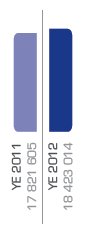
Segmental revenue increased by 3% from R17.8 billion to R18.4 billion, mainly driven by an increase in prepaid airtime volumes. EBITDA increased by 13% from R711.8 million to R801.7 million. Gross profit margins for the segment increased by 0.5% year on year to 5.69%.
As the leading distributor of prepaid airtime and prepaid electricity in South Africa and with an array of a growing suite of products and services, this segment is well positioned to provide retailers, from the smallest individual or spaza shop to major chains, with its product range.
 |
 |
 |
||
| Revenue (R’000) | EBITDA (R’000) |
Prepaid airtime
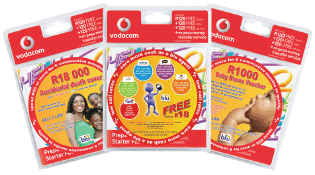
Prepaid airtime and starter pack sales continue to generate the majority of this segment’s profits. The business case is based on agreements to purchase airtime at volume discount prices from each of the major network operators and on-selling at a margin.
Critical to the growth in revenue has been the implementation of renewed urban and retail strategies aimed at further penetration in these respective markets. Services to rural areas have been up-scaled, following the expansion of the outsourced fleet of trucks, which now numbers 60 vehicles and, as ground support, the deployment of 100 foot soldiers. At present these strategies ensure that we are able to reach out to consumers every day and everywhere across South Africa.
Over the year, each of the major network operators increased their prices, which in turn was passed onto and absorbed by the distribution channel. This places an increasing onus on distributors to provide customers with further value adding services, such as call centre support, loyalty, couponing and rewards programmes.
The outsourcing of the POS device and assembly and repair factory yielded a 67% increase in productivity with a marginal decrease in the year-on-year repair cost. This improved efficiency continues to support the decision to outsource this function. The introduction of innovative new devices, which are presently being field-tested with top-tier customers, remains a key focus for the business going forward.
Prepaid electricity
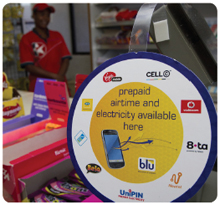
In contrast to prepaid airtime where we act as the principal party, whereas in respect of electricity we act as agent. Therefore only commissions received and not the face value on electricity sales, are included in the reported revenue stream. Prepaid electricity commissions increased by 39% to R85 million from R61 million, due to an increasing number of distributor contracts signed with municipalities, further footprint expansion and growing usage of our proprietary UniPIN product, in both on- and off-line environments. This equates to turnover generated on behalf of the utilities of R5.5 billion, which is currently estimated at about 50% of the total prepaid electricity market.
 |
 |
The growth in this prepaid market is limited only by the speed at which municipalities, utilities and Eskom can meet the increasing demand for installing prepaid domestic meters. Uptake is likely to lead to further innovation in the market, such as the deployment of smart meters. |
|
 Blue Approved
Other products and services
Also available in South Africa through the formal retail, independent store, petroleum forecourt, and corporate/banking sectors are:
 |
Financial Services: Mobile banking, money transfers, bill payments, Electronic Funds Transfer, Near Field Communications, Senda Mobile Merchant |
|
Digital couponing: Intelligent data and loyalty plans |
|
Ticketing: Events and transport |
|
Other: Prepaid water, advertising, Spinner, Superstakes Football, Bela international calling card, Kingo, PlaySALottery, Corporate Governance Tools, Prepaid Pay TV, SportsConnect, MallConnect |
 Operating companies
The following businesses are housed in the SA Distribution segment:
The Prepaid Company (TPC) is the leading distributor of prepaid products for all the major network operators. It also facilitates, manages and maintains, using proven technology developed in-house, the distribution of all virtual products and starter packs. This ensures purchasing efficiency, managing the distribution chain and inventory control. Relationships with each of the network operators is key to the success of this business. TPC is the major contributor to group revenue and profitability, and is responsible for:
|
supplier agreements and procurement for the group; |
|
wholesale and community sales; |
|
sales of bulk printing and starter packs; and |
|
group treasury. |
The Post Paid Company markets Vodacom postpaid cellphone contracts covering airtime and handsets, as well as death benefit and handset insurance products via its outbound call centre, external call centres and various banks, microlenders and retailers in South Africa.
Blue Label Distribution covers some 10 500 POS terminals, including integrated gateways, vending machines, touch screens and RICA devices, nine sales branches across the country situated in Sandton, Cape Town, Durban, Port Elizabeth, Bloemfontein, East London, Nelspruit, Polokwane and George. It provides sales, customer service and field support. A 24/7 customer call centre for merchant and UniPIN support, airtime and electricity sales ensures efficient service. A refreshed management team has been put in place in order to further consolidate and drive distribution into clearly defined formal retail, independent, petroleum and corporate sales channels where significant opportunities exist.
Cigicell distributes virtual prepaid airtime and electricity through a broad network of channels, including formal and informal retail and electronic banking environments. Cigicell is responsible for managing the numerous distribution contracts with utilities in respect of the distribution of prepaid electricity tokens.
Operational overview – International
INTERNATIONAL Operational and financial highlights
|
 |
 |
|
| Revenue (R’000) | EBITDA (R’000) |
In January 2012 the 50.1% shareholding in Sharedphone International Proprietary Limited was sold, as its competitive advantage in the market weakened.
The assets and liabilities of Africa Prepaid Services Nigeria were disposed of in June 2011. The share of losses recorded relate to the costs of winding down the operation.
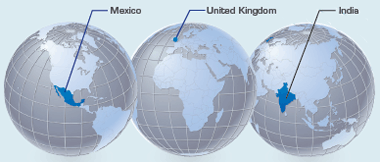
Blue Label Mexico
 |
Blue Label and Grupo Bimbo each hold 40% of the equity in Blue Label Mexico, with the remaining 20% held by local management. Grupo Bimbo, which acquired its stake in February 2011, is the world’s largest bakery business, and has over 700 000 delivery points serviced from some 300 depots across Mexico. The benefits of this relationship underscore the group’s international strategy of partnering in the areas in which it operates. The business in Mexico is based on a number of agreements with key participants in the sales and distribution channels. The main products on offer include PINless recharge, direct top-up and bill payments. |
 |
During the year BLM continued to work alongside Grupo Bimbo on a number of projects, including aligning and integrating systems and processes, ahead of implementing the rapid rollout of POPs nationwide. |
 |
The rollout rate has accelerated while
simultaneously, underperforming POPs are
being redeployed. BLM’s focus remains on
building the distribution network.
Against the background of an aggressive rollout programme requiring expansion expenditure, the share of losses for the year amounted to R25 million. |
Ukash
Ukash, a 17.25% investment, is an international technology operator which digitises prepaid cash. Ukash is patented, proven and scalable. An end-user receives prepaid (Ukash) vouchers, which are ideally suited for redemption in online environments, enabling consumers to use e-cash vouchers to pay, play and reload online. Ukash is now available at some 440 000 locations across 55 countries on six continents, with new locations recently added across Europe, Canada and Latin America. Initiatives in the current period include the deployment of a new core processing engine to improve capacity for future growth.

Ukash is proud to have won the Queen’s Award for Enterprise in International Trade for the second year in succession. Year on year the business continued to show strong growth, as measured by an increase in revenue of 57% with a gross profit margin increase from 49% to 53%, all reported in their local currency.
Oxigen Services India
In June 2011 Blue Label increased its shareholding in Oxigen from 37.22% to 55.83%, with the remaining 44.17% held by local management.

Oxigen became a profitable entity during the year, with our share of profit at year end amounting to R4.6 million.
Oxigen’s strategic shift to a versatile provider of payment solutions, mobile wallets, international remittances and cash cards, is rapidly taking hold.

The traditional business, confined to prepaid airtime, has been augmented with prepaid subscriptions for mobile and satellite TV, transport ticketing, cellphone vending, bill payments and financial services through no-frills kiosk banking. Key to the evolving strategy are the partnerships forged with major players in the industry, who in turn are developing products and services, particularly focused on accessing the country’s unbanked population, currently estimated at 52%.
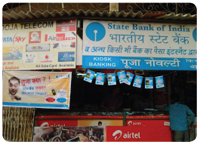 Oxigen’s relationship with SBI, the largest
commercial bank in India, strengthened
during the year. In addition to Oxigen providing
kiosk banking through the business
correspondent model, a long-term technology
and marketing services agreement was
signed with SBI for the introduction of its
mobile wallet. SBI’s Mobicash will enable their
150 million bank account holders to make
payments and money transfers amongst the
vast unbanked and banked population, with
more products and services in the pipeline.
Oxigen has also signed a strategic initiative
agreement with Yes Bank to expand its
domestic remittance business to multiple
banks across the nation, using the National
Electronic Fund Transfer process. Late in
2011, DLF Pramerica appointed Oxigen as a
service provider for its traditional insurance
products, which have since been offered in
several markets. The National Payments
Corporation of India, the country’s national
switch, and Oxigen, jointly launched a mobile
merchant payments system, believed to be
one of the first of its kind in India.
Oxigen’s relationship with SBI, the largest
commercial bank in India, strengthened
during the year. In addition to Oxigen providing
kiosk banking through the business
correspondent model, a long-term technology
and marketing services agreement was
signed with SBI for the introduction of its
mobile wallet. SBI’s Mobicash will enable their
150 million bank account holders to make
payments and money transfers amongst the
vast unbanked and banked population, with
more products and services in the pipeline.
Oxigen has also signed a strategic initiative
agreement with Yes Bank to expand its
domestic remittance business to multiple
banks across the nation, using the National
Electronic Fund Transfer process. Late in
2011, DLF Pramerica appointed Oxigen as a
service provider for its traditional insurance
products, which have since been offered in
several markets. The National Payments
Corporation of India, the country’s national
switch, and Oxigen, jointly launched a mobile
merchant payments system, believed to be
one of the first of its kind in India.
In this dynamic environment, technological innovation is recognised as a competitive advantage. According to data from the Reserve Bank of India, in 2011, Oxigen was processing over 90% of the country’s mobile banking transactions by volume for its partner banks. The ‘Oxisecure’ platform continues to be developed for handling future growth in transactional volumes. Deployment of the ‘Oxismart’ GPRS, ultra-low cost, battery operated terminal, reached 20 000 POPs since its launch in July 2011, providing reliable connectivity across urban and rural footprints. The ‘Oxismart +’ terminal, offering additional functionality, will soon be launched to market.
At year end Oxigen had about 100 000 retail outlets, serviced through 1 135 distributors and looks to deploy some 30 000 POPs in the year ahead in a total market of only around 600 000 terminals. This scale gives Oxigen a strong market presence and holds the business in good stead for the future.
Operational overview – Technology
The segment is responsible for the group’s core technology systems. Its objective is to develop, deploy and support technology platforms across the group and at a number of third-party partners. The segment handles about 400 million transactions per month.TECHNOLOGY Operational highlights
|
The segment’s strategic intent is to develop commercially viable and functionally rich transaction engines, while ensuring investment in technology is optimised across the group. By necessity this requires the segment to provide stable and robust operating platforms and end-to-end support for technology applications, delivered by appropriately motivated and skilled IT professionals.
The group’s two main transactional platforms, the proprietary Aeon and the banking grade Postilion, connect into South Africa’s telecommunication operators, utility companies and major banks, providing both debit and credit card acquiring services, EFT transactions and e-token products for some of the country’s leading retail and petroleum companies.
The core technology service offering includes:
|
facilitating secure financial transactions; |
|
providing and enabling various types of secure e-tokens; |
|
operational support to these e-token and transactional systems; |
|
POS device and customer field support; |
|
hosting and management of IT infrastructure; and |
|
sourcing and maintenance of devices in the field. |
In Blue Label’s business environment of significantly increasing transaction volumes, focus on optimising the group’s systems and platforms in respect of capability and capacity was of paramount importance. In particular, the robust performance of the AEON switch was enhanced to provide additional availability and scalability. Apparent gaps in skills were also addressed, and the segment’s development and operations teams were restructured, ensuring ongoing effective service delivery to the group.
 |
 |
|
| Revenue (R’000) | EBITDA (R’000) |
The group’s EFT capability continues to be provided by the subsidiary, Transaction Junction. During the year the project to roll out EFT services across the country for a major FMCG retailer progressed steadily.
The Technology segment’s focus remains on the continuing use and optimisation of the group’s proprietary core transactional competencies and platforms. In addition, a significant effort is being made to deploy platforms into a number of public and private cloud environments, in order to ensure scalability and deployment of platforms to support rapid and large-scale roll-outs, such as in Mexico.
Operational overview – Mobile
The segment provides a complete mobile ecosystem for customers wanting to add mobility to their traditional channels, e.g. smartphone, WAP, JAVA, SMS, USSD.MOBILE Operational highlights
|
Mobile segment
Our ecosystem allows for the rapid rollout of mobile-mediated sales, financial services, banking, couponing, loyalty, rewards, ticketing, transport, NFC, media advertising, gaming and location-aware services. The technologies and products developed enable our customers to reach their customers, regardless of which type of phone or mobile operator is being used. The segment comprises two main operating entities, Mobile Services Company and Cellfind.
Core net profit increased by R6.4 million, excluding the impact of the non-recurring confidential income.
Blue Label One trading as Mobile Services Company (MSC)
MSC houses the mobile services and media businesses. A number of projects advanced – in sales, advertising and marketing, NFC, transport and commerce, as well as couponing and loyalty. BLMcloud.com was launched, enabling third party developers to use MSC’s ecosystem, while a suite of NFC and other contactless technologies were engineered, bridging the gap between mobile and physical transactional services. Some of the products brought to market in the year include the Spinner range of games, Senda mobile merchant, SportsConnect and MallConnect loyalty programmes.
Cellfind
Cellfind is the group’s WASP, aggregator and Location Based Services provider, deriving mostly annuity income from location based services delivered to the major mobile network operators. Two new products, miPayslip and miStatement, which provide a quick, convenient, secure and cost effective method of distributing information to a target base of staff or customers, gained ready acceptance in the market. Looking ahead, we will be enhancing our SMS aggregation capabilities for the group and third parties.
Operational overview – Solutions
The segment specialises in marketing cellular and insurance products and services through outbound telemarketing, providing inbound customer care, technical support, as well as data and analytical support services.SOLUTIONS Operational highlights
|
Blue Label Solutions
This segment houses Blue Label Data Solutions, CNS Call Centre and the Velociti call centre. Blue Label Data Solutions is accredited by the Direct Marketing Association of South Africa.
Core net profit was up 202% from R7 million to R21 million, mainly attributable to the results of building sustaining relationships over the years with a number of high-profile customers to provide them with direct marketing strategies. The data environment continues to grow well and is delivering various revenue generating opportunities beyond the segment’s core business proposition. The call centre business remains challenging, as it is largely dependent on the marketing campaigns of third parties.
| ^back to top |